Pages

Friday, 14 December 2012

just a little thought

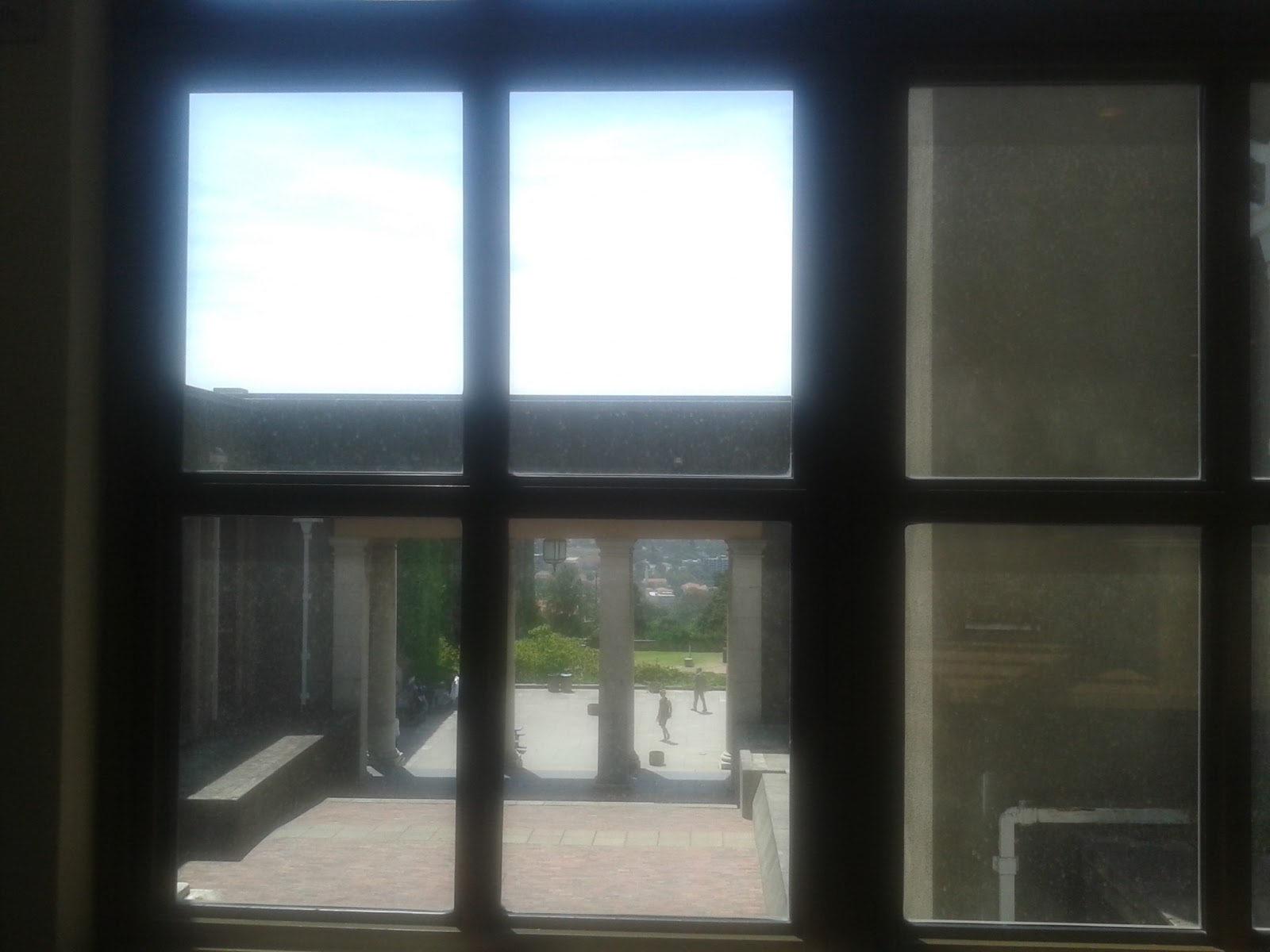
a crap picture of my window view from UCT library
Yesterday while sitting in the UCT's library and watching students gather for their graduation ceremony outside Jameson Hall I had this thought. I had been reading through and reflecting on the comments I received from a really insightful 'reading' of my methodology and data chapters. I felt like I finally knew what this thesis was about and in that moment I felt so powerful, so in control and in charge. It made me wonder why this feeling was so silent from the rest of my experiences of the PhD. It reminded me of something I was taught as a really young person while grappling with the ideology of apartheid. I came to understand that it is in the oppressor's interest never to allow, or to severely restrict the oppressed's realisation of the power they have to change the situation and this mechanism functions to keeps them in continual oppression - I've often heard Bantu Education explained using this analogy. But it rang true for me too.
I thought 'Imagine if I realised or was constantly encouraged to see my power throughout the PhD experience? Just imagine!'

That glimmer of the power of my insight and developing understanding of my thesis now needs to be cultivated - I must never lose sight of it, in fact it must be nurtured and allowed to blossom. Therein lies the possibility for turning things around.

Sunday, 9 December 2012

stuck and getting unstuck

I've been stuck...since Tuesday I would say, trying to write or make some progress on the all important Interpretation and Discussion chapter. When I last wrote I said I would sit down and write...I tried this on Thursday and came up with a blank page - well I did lots of brainstorming but everything seemed so lame, so unbelievable, lacking plausibility. The problem plaguing my writing of this thesis all along reared it's very ugly and destructive head! I want everything to be worked out in my head before I write and because it isn't this major blockage occurs. Also I want my writing to be perfect the first time even though I know this is an impossibility (as the many, many draft versions of everything I've written so far suggests). So instead of committing to paper my thoughts and ideas no matter how rough, I spend all my energy fretting about all the gaps in my argument and how R & M and anyone for that matter, will see all the obvious holes in my discussion. 

In desperation I turned to the supervisors - as you do in such times. Besides the very helpful practical suggestion offered, especially to counter the negative writing pattern that seems to overwhelm me, I got this little gem...and it is a gem because I think it so beautifully captures where I need to get to and how I need to trust myself

I think, in the end, it will be about you coming to a stronger sense of what/who you have actually been studying and why - this sense will belong to you and no-one else will be in a position to gainsay it on either methodological or conceptual grounds simply because they won't own it like you do. Trust yourself on this.

I have become a bit unstuck (wrote 1000 words yesterday) and think as I head into the new week it will get better and I might have an 'goodish' Draft 1 of the Interpretation and Discussion chapter come Friday/Saturday. 

Thursday, 6 December 2012

interpretation and discussion

I've been delaying, putting off and avoiding. I'm resisting sitting down to write this something that will eventually morph into a chapter that outlines my interpretation and discussion of my research analysis. Should this be called findings? I guess that is what it is. My chapter titles at the moment are not sexy, they aren't personal - they are very formulaic and follow the prescriptions set out in any 'how-to' books on doing a PhD. Maybe the sexiness will still come...we will see.

But my main problem has been this inability to want to deal with the interpretations - in effect tying down the crux of the thesis and really saying what the research is all about. Thoughts about this have been drifting in and out of my mind for weeks now, especially as I've been writing and rewriting my analysis chapters. Just yesterday I tidied my study, as my niece has become the temporary tenant of this room in my flat, and I found version upon version of my analysis chapters. I think it would be underestimation if I said I've rewritten those chapter more than 10 times over the past 12 months. But the key issue now is to decide what the hell I do with everything written in those cases.

To feel like I'm doing something about this issue - even though I'm not writing (but we all know writing is the only thing that counts) - I've been reading what other people say and do about this section of their thesis. So I consulted Kamler and Thomson and attempted what they call 'conversational moves' which is essentially where you set out the argument you are trying to make in each chapter. So my argument is a weak and convoluted one at the moment, and I actually think this exercise will be more helpful once I actually have the two ends of the thesis i.e. the introduction and interpretation/discussion, worked out. I've also been reading other people's theses - but we all structure our work so differently - so none of the theses I've read have presented their analysis as two separate case studies. Most people have identified specific themes and construct their analysis around these themes. Another common strategy is to draw together some analytical and interpretative insights at the end of each of such thematic chapters. My themes have become embedded in each case study presentation. I have also kept my case study analysis 'clean' and uncontaminated with theoretical interpretation. I was hoping that the interpretation and discussion chapter would attempt to lift out the themes from both cases and then subject them to theoretical scrutiny.

So this weekend, starting today, I will just sit down and freaking write!
- How is the theory helping me to explain and understand the case studies?
- What are the answers to my research questions?
- Do the case studies actually relate or touch on the research questions?

Let's see how this goes - I need to be brave, like a warrior or something and just face this thing head on.
Monday, 3 December 2012

a final something about HELTASA

The last day of the conference was possibly the best for me. I didn't expect it, it just happened. I was late - very late and rushed to the final session of the day before the keynote. A session on post-graduate writing. LT spoke about trying to understand and make sense of student writing through the concept of risk. A little pedagogic intervention of a writer's circle that was not an overtly framed pedagogic intervention. The stories of the students - not the simplified, washed out and heard-it all before writing journey - but a deeply situated, personal-contextual insight. Nothing you could possible get from a 'how-to' book. And I sat there and thought - this is why I can't give up 'the student'. In fact this final session probably came to symbolise, and dramatically so, much of my conference experience where I had subconsciously sought out presentations that addressed the theme of the student. Why, because I know that my PhD does not, wasn't able to attend to the student voice in the way that I probably would have liked. It's always been a tension in my work, acknowledged by myself but always under the surface. What this final presentation brought home was the fact that I want to address this tension in my thesis. I decided right there that it will have to be an issue that I give prominence to. The student has to be central to what I do - and my professional life after my PhD will have to be framed with this position in mind.

I thought of the very first HELTASA conference I attended at the end of 2003 I think - it had been a tough year for me professionally and personally and I stood in the midst of all the conference goers and thought to myself - This is where I belong. Walking out of the presentation I felt a similar buzz, a similar sense of excitement, a feeling of being in the right place, being pointed in the right direction and of coming home.

Saturday, 1 December 2012

PhD narratives

You can't go to a conference like HELTASA as a PhD students and not get into a conversation about your PhD. Either it's with people who have finished their PhD's and then offer commiserations on your experience saying how hard it is and that only by going through the whole thing do you fully understand exactly how hard it really is. Or it's fellow PhD students wondering how far along you are and then you sort of huddle together offering kind words, advice, sympathy and support but deep inside you're vexed by the underlying competitive tone and degree to which you have to save face by telling distorted stories about the reality of your progress. Three years full time and still not done? I hear them say to themselves and even though I don't want to, I feel somewhat obliged to offer some plausible - meaning outside of my control -explanation for why I'm 'so behind', like I had to wait six months before coming to SA to collect my data.

Most of the PhD narratives that I've heard  from people here though have been positive ones - they love their supervisors, love their topics, love the whole experience save for the odd frustration here and there and the 'hard work' it takes. In such an environment I shut up, smile politely and accept that I'm not the post-girl for the PhD, while trying hard not to feel resentment that their experience appears infinitely more positive than mine. I try in those quick moments to simply accept that everyone is entitled to their experience and I don't have to spoil it by pissing on their parade by telling my story. I have come to realise that it's not important to tell my story anyway or rather that I don't have to tell the real story to everyone. In any case if I did tell the 'real' story is such a fleeting way the reasons for my experience would never be revealed - I could never capture of the complexities and multivariate explanations for why things have come to be the way they are. It's not simply because of my supervisors, because it's at the OU, because it's in the UK, because of the cultural differences, because of language and writing expectations, because I lack confidence or don't have the intellectual ability, because the writing rules are different, because I need different things to learn effectively, because, because, because... How do you explain such complexity to an distant acquaintance  in 10 minutes without compromising yourself and your supervision team. I've also become conscious that even though it has been my experience I don't want to be complicit in these general PhD narratives of doom and gloom. Especially the stereotypical rendition of these narratives. I don't think it should be this way in fact I guess deep inside I believe one should love your PhD in all it's fascinating aspects.
So it's better to smile politely, express genuine interest and enthusiasm for the story being expressed, show empathy when required, but keep my mouth shut about my own experiences except to say how interesting but challenging the journey has been so far.

Friday, 30 November 2012

I have lots to say

I've just attended the annual HELTASA conference in Stellenbosch and I have this overwhelming desire to write, write, write about my experience and how it reflects my ongoing thoughts and struggles associated with being a PhD student. I wish I had taken the time to write in reflection on each day I attended the conference. Writing now feels almost contrived - retrospectively censored. Also because I have so much to say I'm going to have to say things over a couple of posts so the distance from the actual event will become more marked. But hey I can only work with what I have.

Day One - Wednesday

I presented my first PhD related work within a formal academic conference environment on Wednesday. As I got closer to the day I become more anxious. My usual anxiety I guess especially since I only started working on the main focus and thrust of the argument little over a week before the conference. So I didn't really have time to consider other ways of thinking about the presentation. As usual I probably spent more than 8 hours working on a 15 minute presentation. I felt anxious that I needed to get the whole thing right. I saw myself as an outsider and in a way I played on this by deciding not to signal my affiliation to my local institution on my presentation slides. Initial I wanted to say something cheeky about my OU affiliation and my South African accent and how this might have puzzled people in the audience hoping to hear a British academic speak. But I abandoned this little comic interlude on the last minute because I thought it would be too cheesy. I decided I would simply present and allow people to draw their own conclusions about who I was and why I was there. In the end I didn't even introduce myself to the audience...talk about performance anxiety. At the back of mind I kept thinking - I have to be good, I can't give people any doubts about the quality of my educational experience in the UK. I'll always stand in judgement somewhat unfairly because I've gone outside the country. I feel like I need to try harder just to get to the level where the other South Africans are.

Generally, except for keynote speaker, most presenters at academic conferences do a sort of 'off the cuff' presentation. I remember a time when I did this too relying mainly on memory joggers - little bullet points to reminder me of what I wanted to say. But since being in the UK I have completely abandoned this approach and now only use a full script. I'm really conscious that by doing this I don't completely 'conform' to the 'perceived' way of doing things at such events. But I've grown confident in an 'I don't care' attitude about this practice I have. Interestingly, talking to colleague who I really respect at a cocktail function later that evening, she commented that she only presents using a full script - she always has and won't do it any other way. I felt a found a little kindred spirit and it was rather reassuring that I'm not on my own. We both felt confident and assured  - because it works for us it had own internal validity - it doesn't need anything else. YAY!

Back to the presentation - well 15 minutes came and went, rather quickly actually. And then NO questions. That awkward silence when the audience stares back at you, some with a glazed over look in their eyes and you wonder 'Why the hell did I put so much effort into this?' Seasoned academics often mention that they are very selective about which conferences they attend, choosing only to go to the conference that best match up with their research interest and where they feel they will get the best response from their engagement. Novice, wann-a-be's like me take what I can get and therefore the response I got can be seen almost as an occupational hazard. The consolation - and yes there was a consolidation - preparing for the presentation has helped me to think more clearly about the main point my analysis was trying to make about the particular case I was talking about. The presentation is definitely the first step I want to take in crafting a paper about this case study analysis. So what I'm taking away from the somewhat deflated experience is that it had less to do with the specific performance and more about the hidden gains derived from the experience - but then I would say that wouldn't I!

Tuesday, 20 November 2012

addicted to tea

I can't stop drinking tea. I sit on my backside, staring at a computer screen for most of the day and all I want to do is drink tea. I had all the tea stains scraped off my teeth today and wonder how long it will take before they reappear. The warm Cape Town weather hasn't made any impact on dissuading me from drinking my beverage of choice. Maybe it's my little secret writing comfort.
Looking back at some photos from the study years in MK...seems like the tea addiction might have been cultivated there.

I make progress everyday - the progress doesn't always correspond with my work plans and schedules which are now stuck up on the wall just above my computer screen - so always in focus, always on my mind.
I'm determined though - determined to get that first draft done - before Xmas. I've promised myself that I can consider getting a TV if I meet this deadline...a pretty motivating incentive for someone who is probably addicted to TV too.


Friday, 16 November 2012

good intentions

What is that saying 'the road to hell is paved with good intentions'? No sooner did I make my good intentions known when they were challenged. I had to go to work yesterday to attend a very important and interesting meeting that brought together the schooling, FET and UoT sectors to talk about the provisioning of ICT education. But my plan, what about my plan to conclude the editing of my analysis and research methodology chapters on THURSDAY? So I'm already behind as I step into my new work scheme...how utterly frustrating.

But it's not all bad - I also made the decision to leave or temporarily abandon my social media profile. I de-activated my Facebook account in a bid to focus, focus, focus on my writing. Now I can't randomly click, click, click on Facebook, not so much to genuinely find out what my 'friends' on the other side of the world or the city are doing, but in response to some nervous tick that you know you don't want to do, but do anyway. Yes I miss knowing whether someone, somewhere is enjoying the sunshine or the miserable weather but it is also an energy sapping activity when it takes you away from doing the 'real' and 'meaningful' stuff you should really be doing.

I also realised, yet again, how invaluable Dropbox is to the PhD student. For some unexplained reason I messed up the Word 'Styles' configuration for my thesis yesterday. Suddenly I no longer had a 2nd level of headings. Anybody who knows what I've just described will probably be breaking out in a cold sweat at this point. Dropbox came to my rescue - I could find an earlier version of the document where the formatting was still maintained and 'go back' to that version. I had to do some minor cut 'n paste work but the integrity of the Style configuration was maintained. Massive sjoe!

So as the weekend rolls on and the blue skies and sun make their appearance I know what I'll be doing and where I'll be doing it. Oh happy days.

Wednesday, 14 November 2012

breaking the narrative of mediocrity

For a while now my story has been one of missed deadlines, struggles with my writing, struggles with my supervisors, struggles with the PhD. Overall just a total mediocre showing on my part - everything that could,  did go wrong. In a way I accepted the missed deadlines and all the other struggles and problems - I accepted them and readjusted my plans and continued on, only to miss the next deadline or fail to deliver the standard of work I wanted at the next deadline. It just seemed so easy to give in and not to push myself a little bit more. Recently, I asked myself  'Where is the Lynn of the past? The Lynn who wouldn't settled for anything but the best effort?' She is gone and only a shadow remains in her place. If there is one positive thing my ex-students seem to remember me by is that I did not accept mediocre efforts - I always pushed them to deliver their best. 'Where is that Lynn?'

I'm going to try again. Yes, yet again because what else is there to do except to try again. I'm not ready to give up that much I know. I've got about five weeks to construct Draft 1 on my new timetable and I need to deliver it. I need to detach from all the specific 'issues' and focus on the global - the general theme for the thesis, the overall argument, making the argument visible throughout the thesis, getting a basic but coherent general story running through the entire thesis. This is the task at hand. I have to put aside 'Life' happening all around me and push forward - what a bumpy four years I've had - but five immediate weeks to try again.

Where I currently am - What I've done to date

Where I need to get to and what I need to do to get there

Thursday, 8 November 2012

how to define a successful week

I'm sitting in my lounge on my brother's huge leather sofa (the only furniture in this room that I can claim as my own - is a super cheap plastic table) with a huge vodka at hand. I'm not working tonight.

In making the decision not to work tonight I've decided that I've been sufficiently productive to take a night off. So how am I defining that productivity - by the amount of words added to my thesis? Throughout my time at the OU word count seemed to be the only way success was defined. I remember right at the start of my studies there I found this obsession with the word count a difficult thing to get my head around. Over the years however, I've learnt how to take on that discourse myself. But I'm still not convinced it's the only way one can define your success in this PhD game.

This week I went to a really interesting and stimulating symposium - where I realised that Basil Bernstein is very much alive and kicking...kicking arse actually if the intellectual scholarship of the papers presented over the last three days is anything to go by. I had a Skype supervision, a productive critical conversation with a mentor and friend and just about finalised my second analysis chapter...and it's only Thursday. So does this constitute a successful week? Oh and how many words did I write this week...maybe 1500 - 2000?

I don't think I'm ever going to get away from this 'what constitutes success' dilemma while I'm working on my PhD - if I've learnt one thing about this process it's that you're always in deficit. So even if I finished the freaking thesis this week I would still list at least 10 things I should or could have done.


Tuesday, 6 November 2012

a space of your own


This might sound trivial but it's almost the most joyful thing to have a dedicated work space where you can leave your papers just as you want and when returning to your desk, a few hours later, find everything is exactly as you left it and your are ready to pick up where you left off. This feels like such a luxury after having to share work space with my bedroom for such a long time. I feel totally privileged.