Pages

Showing posts with label South Africa. Show all posts

Monday, 20 August 2018

on being a black woman academic in South Africa

This is a reluctant account of how I've experienced academia in South Africa as a black woman. In the last two or three years in the wake of the #Rhodesmustfall and #FEESMUSTFALL student protests and calls for the decolonisation of the curriculum, of the university, of alles, much as been said about the black experience of academia in South Africa. I've stood on the sidelines, feeling inept and ill-equipped to respond, to contribute to the debate and discussion. I worried that I lacked the necessary or appropriate theoretical or conceptual languages of description most of the other commentators were using and that my 'story' wouldn't line up perfectly with the kind of narratives getting the most traction. The main theme of most of these narratives is that academia is a negative and toxic place for black academics and that most universities, but especially the previously liberal white institutions, make it almost impossible for black staff to reach the same levels of achievement as their white peers or that when black academics do succeed, it comes huge personal costs. While, I'm not going to dismiss the validity of this particular narrative or the experiences of individuals that might have lead to the construction of this perspective of being a black academic in SA, I think some refinement and nuance could expand the narrative and reaffirm the variation of experience. Thus while this theme might be rather prominent in our current discourse, it is but a narrative; not the only one.

What's academia like - according to Lynn
Academia is not an open, inclusive and welcoming professional environment. Rarely will you be greeted at the gates with warm, open arms by colleagues keen to offer you all the support and development opportunities you need to become the very best sociologists, physicists, historian, economists, educationalist you can be. The progression up the ladder of success is clearly demarcated and carefully policed; then further tainted with visible and invisible hierarchies of status and privileged conferred on certain institutions, departments, individual scholars. So that your hard earned PhD might not be bestowed with the same quality or legitimacy, as those of your colleagues. Then it is unlikely that your hand be held by an experienced, seasoned and gentle scholar as you attempt to 'break' into the publication world, affirming all your ideas and writing attempts and ready to offer sage advice and a shoulder to cry on when the article you pissed blood to write, is unceremoniously rejected. Also nobody will be at hand to walk you through the indecipherable and many times incomprehensible application processes for study, research or sabbatical leave or conference funding. You will find lots of networks, cliques and cabals that advance their own interests and privilege. These are defined on the basis of discipline, sub-discipline, race, gender, or any other delimiter, arbitrary or not. So just like in high school, but unlike high school, the stakes here can make or break your research career. Similarly, it is assumed that if you have a Masters or PhD, you can teach, develop a curriculum and understand and implement the necessary pedagogic strategies deemed crucial to enhance your students' learning. Again don't expect that anyone will show you the ropes.

Academia is a highly performative environment where the object of display and performance is your individual cognitive and intellectual ability - all your worth is locked down in your capacity to display and prove your knowledge and intelligence associated with your discipline. Furthermore, the manner of this display and how you represent your intellectual worth is governed by particular norms and conventions very often linked to language use specific to your discipline or sub-discipline. So it’s not enough to know, you also need to know and master how to express what you know. If you are keen to move up the ladder of success within the academy you have to show excellence in teaching and scholarship. However, in most university sectors, both locally and internationally, research trumps teaching. So in order to build your research profile and publish you will have to, especially in your early career, do most of your research and publication writing after hours, because most of your 'work hours' will be spent servicing your teaching and administrative obligations.


Unfortunately, the discrimination, prejudice, racism, sexism, ageism and meanness that pervades our society isn't blocked at the university gates. Instead it finds fertile ground and is accentuated in a professional environment built on the mostly subjective evaluation of intellectual acumen; with the one's doing the evaluation imbued with all the power. Add to the mix a healthy component of mean, egotistical people who come in all the race, gender and class shapes and sizes, and you have a setting for a perfect storm.

Insert Lynn - a black woman academic
  • I've worked in higher education for more than twenty years, doing many different things. I started to lecture just over 15 years ago, but I only started to self-identify as an academic about 10 years ago when I started to engage and participate in the scholarly debates and dissemination of knowledge associated with my disciplinary field.
  • I've only ever worked at a historically black institution (although now it’s part of a merged institution).
  • The only position I was even held back from was for a more senior coordinating role. Even though I was more qualified (I was the only lecturer with a Masters degree) and had more experience than my colleagues, my black male boss at the time didnt think I was suitable. I was the only female working on the programme and the position was awarded to my male colleague.
  • A request for conference funding was once turned down by my black male boss. I decided to pay for the conference myself.
  • I was removed from my teaching allocation on a course by my black male boss, because I was deemed to be too critical of the curriculum content and pedagogic approaches used. He also refused to appoint me as course leader even though I was the only female PhD lecturer in the department, and the course I was teaching on was in my specialist area. I had to 'report' to a junior female member of staff who had a contract position.
  • Male colleagues of all hues and persuasions have thought it ok to comment randomly on my appearance, clothes, weight, marital status, or disregard my title in communiques while paying careful attention to correctly apply the all important, prefix signifiers of rank, when referring to all the other male recipients.
  • I have been referred to as a 'token black' by black female colleagues, who seemingly feel I'm not suitably qualified to work in my current domain, even though they don’t have any experience in the said domain.
  • I have encountered black male colleagues who fail to acknowledge both my qualifications and reporting role, and constantly defer to my white male boss, even when I'm at the same meeting.
  • I've seen how white research networks operate and how access to these networks are carefully controlled. Membership is bestowed to only the most suitable black academics. When you say no, you worry for your reputation and career progression.
  • Friendships, authentic collegial and intellectual engagements are possible across race, class, gender and age divides. It’s hard to find, but I've flourished as an academic from the many genuine and supportive relationships I've managed to develop at my own university and with colleagues in my region and internationally. These relationships jump happily cross whatever  race, gender, class, age, cultural 'barrier' put in its way.
MPhil, UCT 2007

So what is it like to be a black woman in academia in South Africa? It depends really - on where you work, who you work with and who you work for. All these variables along with who you are as a person will coalesce and determine what it means for you. It’s a tough space, generally, and there are personal and structural factors that either compound and exacerbate that toughness or smooth it over. 

For me being an academic is almost a constant struggle against all that I am, because who I am is in so many ways at odd with the norms, conventions and predispositions of academia. The academy and its many people, unfortunately, have a low tolerance for difference – so if you don’t look, sound, behave, think or share the same values as those who have the power to define the norms and conventions – then you are more likely to have a difficult time. And often time the structures inherent in the institutional fabric will allow those in power to exercise their power in harmful ways. I’ve been on the receiving end of this kind of power (and meanness) held by both white and black men and women. In spite of this I've been moderately successful, I believe because I have, in part, being able to harness social capital gained from going to a white university and then completing my PhD in the UK. But I also have a particular personality - 'I don't take kak from kabouters' - and if I want something I find a way, legally and ethically, to get it. And I 'graf''. I do the work. Some of the challenges I face are linked to my race, ethnicity and gender, others reference the cultural capital I either possess or don’t (manifested in how I sound when I talk or my writing style). Luckily for me, these challenges, have been only that - challenges, that I constantly have to work at and navigate around. And I’ve found support in the most unlikely places and so have avoided those perfect storm conditions, that can make your life as an academic truly toxic and negative. 

This is a reluctant and incomplete account of being a black woman academic in South Africa - heavily inflected by time and place. I've tried to make sense of my own experiences and how it 'fits' into other narratives and discourses circulating at the moment. Hopefully, my story doesn't deny the other stories being told, but builds out just how discrimination and power manifests within the university. 

Wednesday, 16 May 2018

talking about South African higher education in Sweden

On Monday I did a little informal presentation on the South African higher education landscape and my work in academic development, with colleagues in the Division of the Development of Teaching and Learning, here at Uppsala University. Although the timing of the presentation was a bit 'off' - it could have come earlier in my stay at the unit - I was finally given a chance to reflect on the sector I work in. Also opportunistic was the fact that I'm currently preparing to scope out the chapter of the collections book I'm editing, and this requires a good placement of the ECP within the contextual realities of the South African landscape. All very simple, right?


Many of the Swedish colleagues had been to South Africa, some even to educational conferences in South Africa, so they all had a view, however that may be framed, of the country. Mostly a combination of the shiny, positive stuff and some recognition of the more challenging bridges yet to be crossed (especially from those who went to conference in SA). Two questions I got asked made me think about the angle I had taken for my presentation. I was asked "How would one know you were White in SA under apartheid?" and "What about gender and disability, how are these reflected in student/staff profiles?" Are we as South African's obsessed with race? Is it the only lens we use to see ourselves and what and how we encounter the world around us? Did my presentation really harp on race as the all important factor shaping and driving the sector and the work many of us pride ourselves on doing?

It didnt help that the night before I was particularly aggravated by the inane but unashamedly racist mutterings of my CT neighbours in the 'whatsapp security group'. I lashed out, calling out 'their' inherent racialised beliefs that always linked 'blacks' to crime and their totally self-imposed removal from the realities of South Africa. Rather I should say - their efforts to recreate in a by-gone era where their neighbourhoods really were lily-white - without the slightest recognition that to achieve that status quo meant the denigration by force and law, of anyone who didnt look like them. So I was angry!

My race politics and the shape it takes, has little place in Sweden, and it had little place in the UK, while I lived there. It is uniquely South African. I know I also get irritated by 'the angry black 'x' or 'y' types' I encounter at work or via social media. I know I don't only see race and I know both black and white people can be 'despots' or 'humanitarians'. But I also feel the anger, the collective anger of being on the receiving end of racism in all its shapes and forms. Maybe our society in SA and world at large needs to change before I can take race completely out of the picture.

Thursday, 7 August 2014

a PhD by another name

At the risk for coming across as a snob and slightly superior - I'm becoming increasingly annoyed when people, particularly at my institution, deliberately conflate a Dtech degree with a PhD. All of a sudden, despite prescriptions by national government that suggest the opposite, my institution appears to be offering PhDs. Colleagues I know who have completed or are completing their doctoral studies at our institution, talk about their PhDs. In our internal media publication this week, reference was made to systems being put in place to increase the amount of PhDs graduating from the institution. I read a draft of a journal article written by a recent institutional Dtech graduate, that blatantly referred to their study as a PhD research project. Surely all of this smacks of dishonesty. They know they aren't doing a PhD, nor did they graduate with a PhD and they know our institution doesn't offer PhDs. I'm all for recognising and acknowledging the merits of a particular qualification based on the defining parameters of that qualification, but when you pass one qualification 'off' as another, you inadvertently draw unnecessary attention to the quality, status and worth of the qualification being airbrushed away. The status of the replacement nomenclature becomes elevated, while that of real qualification diminished. Or maybe for the people doing it, they're actually hoping their Dtech qualification is conferred with the same status as the PhD.  Now it could be that the term PhD is the more common and familiar, so more likely to be in people's consciousness. But, the same could be said in other countries where PhDs and other professional doctorates make-up the qualification mix. Yet I've never heard an EdD mistakenly, or otherwise, referred to as a PhD in England. So is this parlance a South African phenomenon? And more importantly, why is this causing me so much irritation? Maybe underlying this little outpouring of irritability is a superiority complex which I should acknowledge. I don't really want my PhD conflated with a Dtech, thank you very much. Status, or rather the perceived deferential status of these two qualifications, is really at the heart of this (my) problem. But this conflation exercise, as I describe above, isn't doing anything to address the status inequality, rather I think it simply perpetuates it.

Wednesday, 7 May 2014

20 years on

I wanted to write about the 20th anniversary of South Africa's first elections two weeks ago, but all I did was think about what I could say. Today I went off to vote in our 4th national election since becoming a political democracy. Maybe it's the conversations, debates and slight turmoil about who to vote for, that has accompanied me over the last few weeks, that crystalised today in my determination to put my thoughts down.

Thelma a few days before
the inauguration of
Nelson  Mandela
In 1994, for me and most my family it was a foregone conclusion who we would vote for. This was accompanied with much optimism, enthusiasm, even euphoria about the fact that as a country we had reached this momentous landmark despite the bloodshed, destruction and turmoil that had defined the 'struggle years'. I remember desperately waiting to see the results tally and wishing the ANC would get the two-thirds majority that would once and for all show the previous apartheid government (and the rest of the world) the faith and confidence the South African people had in it's liberation movement and political party. Nothing could dampen the feelings of positivity and deep hope for a different kind of future, one defined by equality, for everyone in the country.

Today I went to vote at a Bridgetown voting station. I grew up in this apartheid era 'council area' and accompanied my sister and brother-in-law who still live there. On our way back after voting we were reminiscing about the 1994 elections and my sister made a very simple, but poignant statement. She said it was so sad that after only 20 years all that has become of the expectation, hope, optimistism we felt then, is now, only a bitter taste felt in our mouths.

The last time I voted for the ANC in a National Election was 2004. For the local elections I had unfortunately, already lost faith in party and especially its personalities, before that. But I think in 2004 & 2009 the debates about who to vote for were more predictable. People like me who were a bit pissed off or irritated with the ANC, made a token gesture of either spoiling our ballots or voting for an obscure, small independent party. It was a silent, person statement. This time around the dissatisfaction with the political context was more widespread and had entered the heartland of the ANC support base. I'm defining 'support base' here as people who, while dissatisfied with particular policy or tactical  decisions made or who had issues with certain personalities in the ANC, are by and large still loyal supporters (for whatever reasons). In the last few weeks there have been all sorts of calls, even by ANC stalwarts, to vote tactically, and in so doing give the ANC a wake-up call. For me it's been hard to respond to these calls and debates. In principle I could agree, but on the question of who to vote for I was very unsure. It's one thing to make a personal, and very silent, statement in a voting booth, but a completely different thing to possibly direct your vote towards an opposition party that you find morally irreprehensible, simply because you want to send a clear message to the ruling party without watering down the opposition.
My dilemma today.
My choice about which political party to vote for is still emotionally charged and undeniably scarred by my history. Just like I was unable to vote for the ANC because I see it distorting the ideals it held in such high regard a mere 20 years ago, I was unable to put aside my personal and political beliefs when selecting which opposition party to vote for. As it can be said that most political parties stand on shaky moral ground anyway, does it really matter? Unfortunately for me, at this moment, it still does. I tried to pick the best of the baddies and as a result I probably didn't do my bit for helping to develop a more robust opposition.

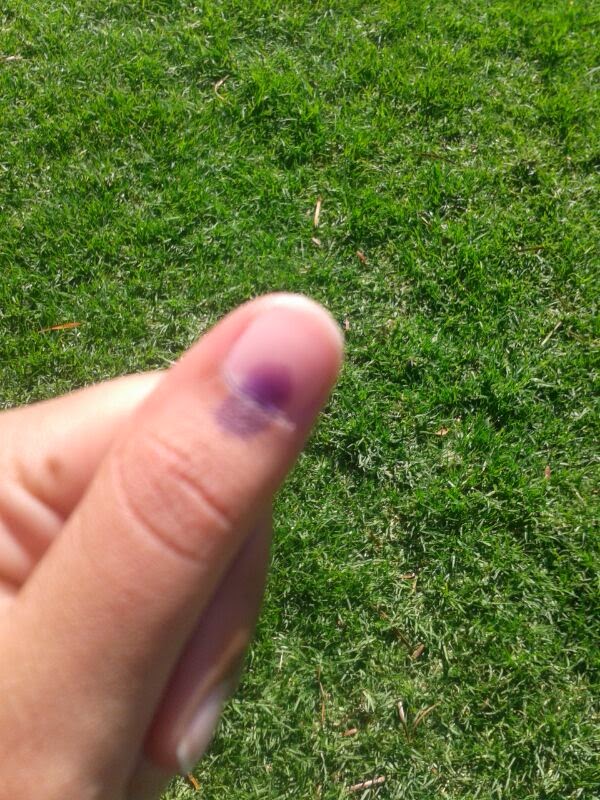
Melissa's ink-marked thumb
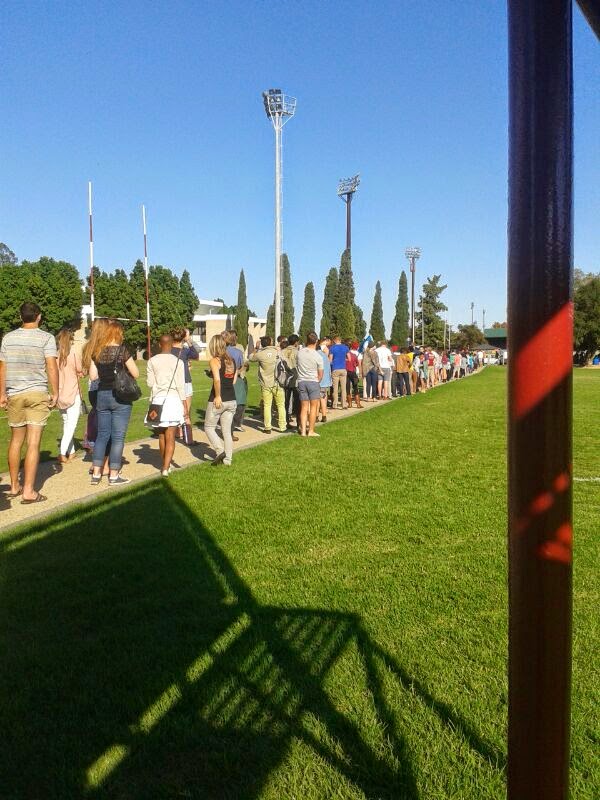
Waiting to vote for Melissa
My niece, Melissa, who was born in November 1994, and therefore a true 'Born Free', voted today for the first time. So a special moment for our family and maybe symbolic too. I'm forced to acknowledge that the political landscape has changed in the past 20 years, and this is positive too. In a way the fact that Melissa had the option to choose an alternative to the party I voted for 20 years ago is an indication that, politically and socially, our country is able to accommodate the necessities of change. And in a small way I feel, through the act of Melissa voting today, the same positivity and optimism we all felt the first time we went to the polls, in what also seems like a life-time ago.


Sunday, 23 March 2014

my students

With an assignment looming one suddenly gets to see your students in ways often hidden from direct view. This strange period in the academic calendar also offers the student an opportunity to seek out and engage with their lecturers in ways probably unimaginable when they first walked through the classroom doors. Over the past two weeks I've had some interesting encounters with my students - moments that have forced me to think differently about these individual human beings, their struggles, their experiences and their expectations. Here are short descriptions of some of these moments.

A rather proud Xhosa student of mine came to my office after class to tell me that his father had died the previous weekend in a car accident. I felt a slight sting of shame, as just 40 minutes before, I had rebuked him for not having done the preparatory readings for the session. He explained as best he could, while trying to maintain an emotionless disposition befitting of his status as the oldest son, how hard it was for him to have to inform his mother and sisters of his father's death. He was also preparing himself to be in the company of his mostly female immediate family as all the funeral arrangements were made and the eventual ceremony in the Eastern Cape attended. We spoke about the possibility of an extension and I explained what procedures he needed to follow for this request.

On the same day another male student of mine spoke to me about his rather tenuous accommodation situation. He was living in a single room in Khayelitsha in a house of a friend of his family. He didn't know the family personally and unfortunately it wasn't suitable - not least because of the travelling and the expectations that he had to help-out with the housekeeping - both these factors were impacting on this studies. He clearly needed to move out, but had not been very successful in securing alternative accommodation options. As a first year student, his chances of getting into a residence at this late stage were slim. This week I received an e-mail from him asking for an extension and explaining that he had to move out and was practically homeless.

During a remedial assignment preparation session I scheduled with my classes I sat with a group of about five mostly Xhosa students. They kept calling me Ma'am - something that had occurred throughout the term even though I specifically asked students to call me 'Lynn' at my first class. Again I said rather sternly 'Don't call me Ma'am, my name is Lynn'. Maybe because of the intimate setting, they immediately expressed their discomfort. 'We can't call you Lynn, it's disrespectful' someone said. Now, I know this, right? Most of my students have had 12 years of schooling, mostly in some or other township where authoritative rules always apply. They also come from a highly hierarchical socio-cultural environment where children, young adults and students need to know their place in relation to adults and especially lecturers at the university. Even in our department its very unusual for students to be on first-name terms with their lecturers. They lamented at how their parents would be most disapproving if they knew, their sons and daughters were calling me on my first name. We had a long discussion about the different ways in which respect can be shown. Through my attempts to convince these young people why it REALLY was ok to call me on my first name, I had to reflect on my own reasons and underpinning philosophies for this stance. I was reminded of my adult education inspired humanist values and how this simple (almost unthinkable) action so strongly attempted to signal an egalitarian approach to education. As a lecturer I really don't need a title to signal my status and power - surely its already conferred on me by virtue of the institutional structures which both my students and I are apart of? But of course while I know this, I'm also critical of this stance. The question for me of course is, shouldn't I be more accepting of my students, their socio-cultural background and find ways to alleviate their discomfort rather than accentuate it by insisting on these rather foreign naming conventions? Well no! As we discussed, different contexts call for different practices and we all have to get used to this in our daily interactions with people in different settings. They will have to come to understand that in my class calling me on my first name is not a sign of disrespect and doesn't in any way diminish my authority. Of course this rule might not apply to my colleagues and their classes and my students will have to change their approaches accordingly. As we ended our conversation one of the young men in the group sheepishly said 'Yes, Lynn' and everyone else giggled nervously. Later, thinking back on this short interaction which forced me to really consider an almost unconscious aspect of my classroom practice - I felt grateful that my students could help me reconnect with this practically hidden, but defining aspect of my teaching self.

Sunday, 15 December 2013

a final goodbye

When I visited Cuba in 2000, I asked why only Che Guevara's face adorned the many t-shirts we saw there and why there were none of Fidel Castro - we were told that, in Cuba only the dead are immoralised in this way because the living can still betray the revolution.

Today I watched from a thousand miles away how Nelson Mandela's body was lowered into the ground. One minute his coffin was visible over the graveside and then, with just a blink,  it was gone. I've been filled with such sadness, and deep reflection that feels at the same time personal but inextricably part of a collective consciousness. I'm in England and all I wanted was to be home in Cape Town, in South Africa, with my family. So I could sit with them and cry, and remember, and debate, and shout at the TV in unison when No 1 offered the world insincere half truths, lied and delivered unemotional cliche sentiments - even though the act of shouting at the TV would showed up our failings, our inability to be like and act like Madiba would.

I don't have any words of wisdom about how Mandela changed my life and how I'm now going to uphold his legacy and do as he would have done. I'm not quite sure when the sadness I feel will leave me even though the acceptance of his death, and this death to come, has been living with me for a while now. What I know now is that I will be proud to wear a t-shirt with his emblazoned image safe in the knowledge that he did not betray the revolution. Hamba kahle, Nelson Mandela, hamba kahle.


Wednesday, 28 August 2013

change is inevitable

I'm trying to maintain a brave face as I tackle the working week. I have good days, when I feel like I've achieved something or I don't feel too disheartened by the mundane tasks I've done all day. The bad days, well...I have bad days.

The most striking thing about being back at work is noticing how much I've changed. It's not only that I have changed, because change is bound to happen over time. It's when I focus on the how that reveals the most significant insights. I feel as if I view my new/old surroundings from OU tinted lenses. I don't think that I'm overtly comparing practices, I'm just acutely aware of how strongly my time at the OU has come to influence and shape my sense of academia. The academic practices I now foreground have a clear OU flavour. I find myself evaluating the saying, doings, valuing around me from an OU position. I say OU but of course it has more to do with my disciplinary alignments, forged very strongly during my time at the OU and the specificities of my supervisors' ways of talking, thinking, doing and valuing. I'm shocked at how much of it I've internalised. It's not necessarily a bad thing, it just creates particular challenges as I find myself operating in a environment where my ways of being bump against the institutional and departmental ways of being. Sometimes I manage these challenges and tensions, other times they send me reeling and seriously doubting myself. I did a bit of English-style whinging yesterday  to my dear friend SB about my re-immersion into working life at a UoT and she gave me some firm advice - Suck it up, buttercup - she said. I think there is something pure and unpretentious about the advice which I can only appreciate. Things will get better and who knows I might even re-acclimatize and change my wayward tendencies.


Wednesday, 13 March 2013

the familiar and the strange

I arrived in the UK on Sunday. It started to snow lightly on the drive up to Milton Keynes. My ambivalence about coming here for a month started to firm up into tangible resentment in the same way you know you have to take a small taste of slightly dodgy milk to confirm that it actually has gone off. Everything is so familar though. It's like I never left almost 6 months ago. I went to see my friend SB, who is trekking across the globe to make a new life for herself and her family today, and even though her daughter is 6 months older and more mobile and attentive than she was when I left - it felt like I had last seen them only a few weeks ago. I just slipped comfortably back into how things were before I left. Same thing happened yesterday when I went back to the flat where I spent my last 15 months in England and popped into the OU. It's all so familiar but strange at the same time. I've spoken about this before, even about coming back to Cape Town - it's an uncomfortable, comfort (that's the best I can do at this point). Although my strong South African accent and my need to infect my speech with little Afrikaans sayings here and there tend to clearly signal that I'm fresh off the plane. But things are different...most of my colleagues aren't at the OU  anymore and I'm probably not never going to have tea with SB in the JLB nexus or coffee with SP in the soft, comfortable chairs in the Hub again. But then I knew that when I left the OU in September, but I guess I expect these familiar OU-type things to happen just because I'm in the OU environment. But things change.

Just like at the moment I feel strange to be a South African in England - I feel like all the bad press about the country lately, has stuck to me in the same way the smell cooked fish pemeanates your home no matter how many windows and doors you open. How do I manage it though - do I tell people what I really feel and appear unpatrotic or do I just dismiss all the very obvious rumblings and unsettling realities of South African society and present a optimistic version of life at the tip of Africa? The society I live in is complex, fluid and dynamic and it is difficult to offer a quick little sound bite that adequately and accurately captures all that is South Africa. I feel I'm going to have to settle into my discomfort at the moment - it will pass, or some of the discomfort will pass. It will be all be fine and I have BBC TV to soothe my conflicted soul. What more can I ask for?

Sunday, 27 January 2013

missing the OU


My old stomping ground covered in the January snow.
 The OU can't be faulted for providing students with the kind of resources they need to complete their studies. This past week I've really been missing having access to these taken-for-granted neccessities. Whenever I need to print long documents (like any chapter in my thesis) I have to trek all the way to Bellville and squat with my colleagues in the GD department to print out my documents. When I need access to a book - well that's almost impossible to get hold of. The library at my institution is so under resourced I don't even bother to check if they have a copy of the book. At the moment I can't get access to the borrowing facilities at UCT because I haven't registered with my institution and then gone to UCT to activate my account. At least UCT generally has copies of some of the books I need - but then I have to lean very firmly on colleagues and friends who work at UCT. But all around this is a very convoluted process. I miss just walking to the OU sitting at my desk printing whatever I need, placing a hold on any book I need from the OU library then collecting it at my leisure and if the book isn't there I can simply request the book from the British Libary and when it's available the library sends me a notification and it is kept in a special place where I can collect it at my leisure. With all this missing of the OU the need to have access to these fundamental resources that are crucial to completing a PhD has been brought into sharp focus for me. Thank goodness I still have access to all the electronic resources provided by the OU. Yeah I miss my desk at the OU, especially at times like these.

Saturday, 26 January 2013

looking back some more, grounded in the present

I've been working at the UCT library since the end of last year. I've always found comfort in that library and it's become a place that gives me a sense of discipline and calm as I try to wrestle with the becoming of my thesis.

I like being on Upper Campus, you get to look down on the world below you, marvel at the space in front of you (the whole of the Cape Flats right until the Hottentots Holland mountains), but feel a sense of safety that you are so far removed from that reality figuratively and rather literally too.

It's 'Orientation Week' at UCT, so there are loads of somewhat bewildered, somewhat bored 18-20 year olds walking around with an orientation leader across the campus. Most often the pack of young beings come into the library, taking in the space, as best they kind while being overloaded with useful'ish information about where the audio-visual viewing area of the library is. I was having my lunch in the open air food court close to the library the other day and just taking in all the new students and their orientation leaders. This group of students are so diverse in relation to the obvious demographic categories and the less obvious aspects of clothing style, sexual orientation, religion, accent, you name it. The level of diversity is certainly more obvious than you would find at CPUT for instance. Somehow I felt good, warm about this. From what I could tell Black students get involve in their university - they are orientation leaders, members of the SRC, RAG, Faculty Student Councils.

I thought back to my first few days as a students at UCT 24 years ago (and I had to count on my fingers to establish how long ago it actually was since I came to UCT). I also did a Orientation tour, I was lead around the campus by some hippie White guy who was a member of the SRC - I don't remember what he looked like but I remember him. It wasn't something the cool students did - by going on the tour you sort of signaled you were new and didn't know things. And in terms of gaining any 'street -cred' you couldn't really advertise your novice identity. I don't ever remember feeling like anybody wanted me to be part of the university or wanted to make me feel at home, or comfortable in that space, or develop a sense of belonging. In fact as I moved through my undergraduate years this feeling of disconnection and alienation intensified. I had no intention of fraternising with my oppressors - I was there to get my degree and piss off, I wasn't interested in speaking to some White person up at UCT who would then politely ignore me if they saw me down in Rondebosch, at the foot of the mountain. In the dying days of Apartheid my time at UCT was not about getting cozy with the oppressors, it was about getting a good education and taking it back to my own community.

Those were such different times, but even then I sought solace in the library. It was a different library then, not the modern, open space environment I often find myself sitting in these days. Back in my day it was a musty, wood-panelled, almost claustrophobic place. Back then, like today, I had my special spaces to sit and would always retreat to little hidden away areas to read and study. And in that way the UCT library symbolises my success, my academic success.

I've been reading again about the higher education sector in South Africa - a system in crisis - and one that can only ensure that less than 40% of the students who enter its doors leave with a degree after five years of undergraduate study. And while that statistic might sound marginally ok, when you disaggregate it for race then only about 5% of the Black student population are successful in obtaining a degree after five years of study. Bottom-line most Black students therefore aren't successful in finishing their course within the stipulated period.

Again I'm taken back +- 24 years ago - I finished my degree in the stipulated period - I am a stark exception. I also know that if I had been in the schooling system today I would never have seen the UCT light of day - it just would not have happened, all sorts of circumstances would have acted against me I think. I can't explain why I was successful with my studies. I just did all my assignments, went to most of my lecturers and tutorials and sat in the library studying (probably the hard, inefficient way). The courses I took didn't always make sense to me, in fact I don't particularly remember feeling a real sense that I understood the discipline I was learning about. I seem to recall that all I ever got access too was a surface level understanding of things. But I passed within the recommended time frame and didn't do too badly (I didn't do well by a long stretch of the imagination, but I didn't scrape through either).

My research, my work, my identity as a teacher are all wrapped up in finding ways to improve student learning. At the moment I'm drawn to uncovering and understanding my own undergraduate learning experience within its specific historical moment within the larger HE project at the time (yes I was a ASP student too, but really didn't understand what that meant, I signed up for the course because I had to - I wanted to do Psychology and couldn't get into the mainstream course without taking the ASP supplementary tutorials) and mapping it onto the research that exposed the realities of South African's current higher education system. In some ways my own learning experience is a helpful reflective lens, and in other ways the contextual realities of contemporary South Africa are so fundamentally different  that trying to bring the two experiences together feels to me like a ridiculous proposition.

I like what I see around me when I sit in the library though - students getting to know their institution and feeling a part of it (these are my perceptions and I know they don't necessarily match the realities that students experience and I know, from the research (and anecdotal evidence), that Black students at UCT are still marginalized and alienated by what they find) - even though my undergraduate experiences at UCT weren't always positive or inviting, and even though I'm critical and cynical about the grand ideals that institutions like UCT project into the world, at a very basic level I have a strong affection for, maybe a kind of loyalty to  UCT and am surprised by the degree to which I have internalised and taken on so much of its values and symbolic capital. Especially at postgraduate level UCT has been the site of much of my academic success. In a way I am because of it  and I think I came to it at just the right times in my life so that I have been fundamentally shaped by all that is good about the institution and all that is/was bad.

Wednesday, 22 August 2012

writing, writing, writing again

I'm working on the first draft of my conceptual framework (aka - literature review) and I experienced the classic sequence of events. I avoid doing the writing for as long as I can, but once I start it's 'sort-of-ok' until, of course, I encounter the first of many stumbling blocks in the writing process. So at the moment, it's sort-of-ok! I know it's not going to be the version that makes it to the final thesis, but it's a start to that process. I spoke to someone who is working on her second thesis draft and her advice was 'don't put too much effort into it because at this stage you don't know where you're taking it and you might end up trashing large sections of work you were sweating over for weeks - the effort can come at a later stage when you are more clear of the direction you plan to take'. Good advice but in order to follow this advice, which is somewhat counter-intuitive to how I tend to work, I've really had to consciously stand back from my need to get everything right the first time. But with my deadline looming I've been forced by necessity to just go with the current version of the conceptual framework. So I'm just tying up loose-ends and making my current argument as articulate as I can. I'll have to wait for feedback and then see where it take me.

One thing that is rather prominent in my writing is it's South African flavour. I'm relying very strongly on SA researchers and scholars. Thinking about this today, as I quoted yet another SA researcher, I wondering if this was partly to make a very important point about the validity, relevance and credibility of SA research. Also I suspect that very few people here might have read the work and maybe this is another way to draw attention to and promote the depth and value of the insights presented in the work. And of course to very clearly signal my identity and allegiance. Selfishly though, I thought - well maybe I can also vicariously gain kudos through the work of my esteemed country men and women.