Monday, 25 August 2014
and I knew I wasnt alone
Thanks to LR, who shared the following with me, http://www.thedailyvox.co.za/sexistsa-academic-spaces-are-far-from-safe/, my suspicion, that what I experienced last week is probably just the milder tip of a massive, menacing iceberg, was confirmed. Unfortunately, the student story captured above, makes my 'little rant' seem like a pleasant stroll on a Sunday afternoon. So proud to see that these women students are actively challenging the patriarchy and sexism they encounter within the SA university context, even though taking such an confrontational and oppositional stance, will probably place them firmly in the firing line. Aluta continua!

Sunday, 24 August 2014
wobble
At the beginning of the semester I was determined that my new positive attitude would rise above all the crappy institutional, departmental, personality-defined politics and culture I encountered. This past week threatened to seriously derail my plans. While I'm not 100% sure why this week, in particular, so threatened my new-found positive attitude, as the week unfolded, a series of events all conspired and quietly coalesced to once again force me to question why I work where I do, whether I want to continue to be there and why, in certain instances, I react so poorly at what I get confronted with.
 Fortunately, I can answer the first two questions without flinching, but unfortunately, the answers will reveal a less than honourable or principled side to me. In many ways it was a slow build-up - little bits of things, possibly over many months, that unfortunately, depleted my tolerance levels. To my credit and maybe a testament to how my new positive attitude has actually changed how I deal with things, instead of highlighting my inadequacies or suggesting that somehow I'm at fault - the past week saw me confront, and challenge face on (sometimes), the insidious, patriarchal, sexist underbelly of the department and institution. Some examples from the past week to illustrate exactly how this plays itself out in my work space: Seeing myself and other female colleagues being relegated to the ones who arrange the catering and venues; Being summoned into a management meeting to 'recount' the logistical arrangements for a curriculum development workshop - even though the programme leader, for whom the workshop was devised and who was present in the meeting, was fully briefed on the what's and how's of the workshop; Witnessing how a senior female colleague was jokingly, invited to 'strut her stuff' on a imagined runway in a formal workshop venue; Then the final straw - when a member of the institutional executive management, with all seriousness, challenged an all women audience, at a women leadership in higher education meeting to interrogate 'What was wrong with women?' Would anyone challenge black academics to question 'What is wrong with black academics?' I wonder? I'm depleted, really. The fact that I was able to challenge and raised my voice to counter some of these viewpoints, almost feels insignificant. I think the extent of discrimination, of all kinds, but especially towards women (both students and staff) within my working space and so reflecting the higher education sector in Cape Town (dare I say South Africa) and the arrogance of those who perpetuate it cannot be underestimated. But, I won't take it laying down and I won't be polite and intellectual about it either. So as we say here on the Cape Flats their 'ma se p$%*!
Sunday, 17 August 2014
discernment
Earlier this
week I was once again surprised by my poor level of discernment. I had
signed-up for a ‘writing for publication’ training workshop run by our Research
‘promotion’ Department. Knowing who was running this course should already have
kick-in my internal early warning system. But I wanted to challenge my own
prejudices and remain open to the idea that I could learn from such an
engagement even if the underpinning philosophy or pedagogy, guiding these types
of skills & support courses, did not sit comfortably with my own views. Second
warning bell sounded very loudly when I entered the workshop venue and found
that the physical arrangements of the furniture and the state of the furniture
itself was so poorly suited to ensuring that the budding academic writers would
be able to sit comfortably and write for more than 10 minutes at a time. The
final straw come after I had subjected myself to the first hours of the work
and the facilitator started to ask different participants to read her slides aloud
as a way of bringing some variation to the presentation.
Thursday, 7 August 2014
a PhD by another name
At the risk for coming across as a snob and slightly superior - I'm becoming increasingly annoyed when people, particularly at my institution, deliberately conflate a Dtech degree with a PhD. All of a sudden, despite prescriptions by national government that suggest the opposite, my institution appears to be offering PhDs. Colleagues I know who have completed or are completing their doctoral studies at our institution, talk about their PhDs. In our internal media publication this week, reference was made to systems being put in place to increase the amount of PhDs graduating from the institution. I read a draft of a journal article written by a recent institutional Dtech graduate, that blatantly referred to their study as a PhD research project. Surely all of this smacks of dishonesty. They know they aren't doing a PhD, nor did they graduate with a PhD and they know our institution doesn't offer PhDs. I'm all for recognising and acknowledging the merits of a particular qualification based on the defining parameters of that qualification, but when you pass one qualification 'off' as another, you inadvertently draw unnecessary attention to the quality, status and worth of the qualification being airbrushed away. The status of the replacement nomenclature becomes elevated, while that of real qualification diminished. Or maybe for the people doing it, they're actually hoping their Dtech qualification is conferred with the same status as the PhD. Now it could be that the term PhD is the more common and familiar, so more likely to be in people's consciousness. But, the same could be said in other countries where PhDs and other professional doctorates make-up the qualification mix. Yet I've never heard an EdD mistakenly, or otherwise, referred to as a PhD in England. So is this parlance a South African phenomenon? And more importantly, why is this causing me so much irritation? Maybe underlying this little outpouring of irritability is a superiority complex which I should acknowledge. I don't really want my PhD conflated with a Dtech, thank you very much. Status, or rather the perceived deferential status of these two qualifications, is really at the heart of this (my) problem. But this conflation exercise, as I describe above, isn't doing anything to address the status inequality, rather I think it simply perpetuates it.
Sunday, 3 August 2014
the trouble with a PhD
Doing a PhD changes you. You never come out of the process the same person who went into it. The trouble though, is that the 'change' is unknown or unpredictable. Most universities, like the OU, outline their expectations for the type of PhD graduate they hope the process will produce. So it's fairly reasonable to assume that 'out there' are a 'standard' set of characteristics or dispositions, which a fairly large group of interested people, expect someone with a PhD to possess. Now some can embrace all these changes and in fact, they change in ways that almost map on directly to these expected characteristics deemed important. They meet their own expectations and those of others, of the person you're meant to become as a result of the PhD. And I think when that happens, it's great, because of course it validates the process and makes all the sacrifices,one invariably makes when embarking on such an intense learning process, worthwhile. There is a sense of achievement and personal reward and fulfillment. I'm glad to say I know a few people who have experienced the PhD in this way, and have revelled in the many positive and validating outcomes of the PhD experience in both their personal and professional lives. The positive personal impact of the PhD is undeniable.
 Others, struggle more with the changes that have occurred and even more importantly, with the expectations of change and types of changes, others expect. I've always been wary of the changes that might happen to me as a result of the PhD, and in many ways this is what kept me from embarking on the process sooner than I did. I was scared that I would change in particular ways - not that I knew exactly how these changes might manifest - I was just apprehensive. And while you can sometimes see or experience how you are changing, while in the middle of the whole thing, I think the full extent of your metamorphosis is only fully realised when you have to re-immerse yourself into 'normal' life and start to bump up against your own new view of the world and the reconfigured expectations of others. I'm feeling this conflict and discomfort profoundly at the moment. I'm trying to work through my own internal conflicts about the changes that I've undergone, but find I'm also confronted by having to negotiate and mediate other people's expectations of me, Lynn with the PhD.
I had an e-mail just yesterday from a friend of mine in England - we did our PhD's together at the OU. He never went back into higher education after he completed his doctorate and is now working voluntarily for an archeological society. He too spoke about the trouble the changes that the PhD demands and is responsible for, and the difficulty with settling back into old environments post-PhD. It's reassuring to know, one can just cut-out your own pathway and that all those letters 'behind your name' don't need to prescribe or determine who you are, what you do and who you want to become.
I had an e-mail just yesterday from a friend of mine in England - we did our PhD's together at the OU. He never went back into higher education after he completed his doctorate and is now working voluntarily for an archeological society. He too spoke about the trouble the changes that the PhD demands and is responsible for, and the difficulty with settling back into old environments post-PhD. It's reassuring to know, one can just cut-out your own pathway and that all those letters 'behind your name' don't need to prescribe or determine who you are, what you do and who you want to become.
Monday, 28 July 2014
will it be better?
I'm back at my desk after a four week absence. A European summer, it appears, is very good for me. I've embraced the prospect of the next five or so months, at this desk, from a position of calm and determination to ensure that my agenda becomes the priority. But this doesn't meant that I will relinquish my responsibilities to my employer, just that I will work smarter to ensure that those responsibilities don't overwhelm me with feelings of guilt or sap all my time. A week in and I think it's okay. I'm not sure if my outwardly projections give any indication that I have a new attitude, but it's more my internal talk that has registered the shift. A main priority is to write - to get an article ready for journal submission come the end of the year. Then I have another collaborative writing project that will culminate in a chapter submission in December and three conference presentations between September and December. So it's pretty busy but my aim is to keep my focus, energy and organisational management strategies squarely on ensuring that these my priority tasks take centre-stage, while I also making sure that my routine institutional work also gets done. Can I get sufficiently organised and 'selfish' about integrating my research and writing aspiration with my institutional obligations? Can I become more efficient and not get sucked into the malaise that envelopes me at work? Only time will tell.
Monday, 14 July 2014
sleeping on the job
I'm on a 'summer' holiday in winter. Summer because I'm currently writing this in the Northern Hemisphere, looking out at the green trees and blue skies outside. When thinking about my holiday away from the 'chilly' institutional context down South, I fantasised about writing each morning and making some headway with my plan to use writing to effectively pull me out of the soul sapping downward spiral I found myself in. As I head into the final five days of my Swedish Summer, I've have to acknowledge, yet again, how distant a fantasy is from reality. To date I've spent maybe three mornings doing anything remotely academic or writing inspired. Lots of ideas, sans action. Of course I'm disappointed. An OU friend who came to visit, reminded me of how lucky I am to have 'free' moments for writing during my normal 'working' time. I felt a tinge of guilt at not fully exploiting that time. Free time without motivation or inspiration is thus a sad thing.
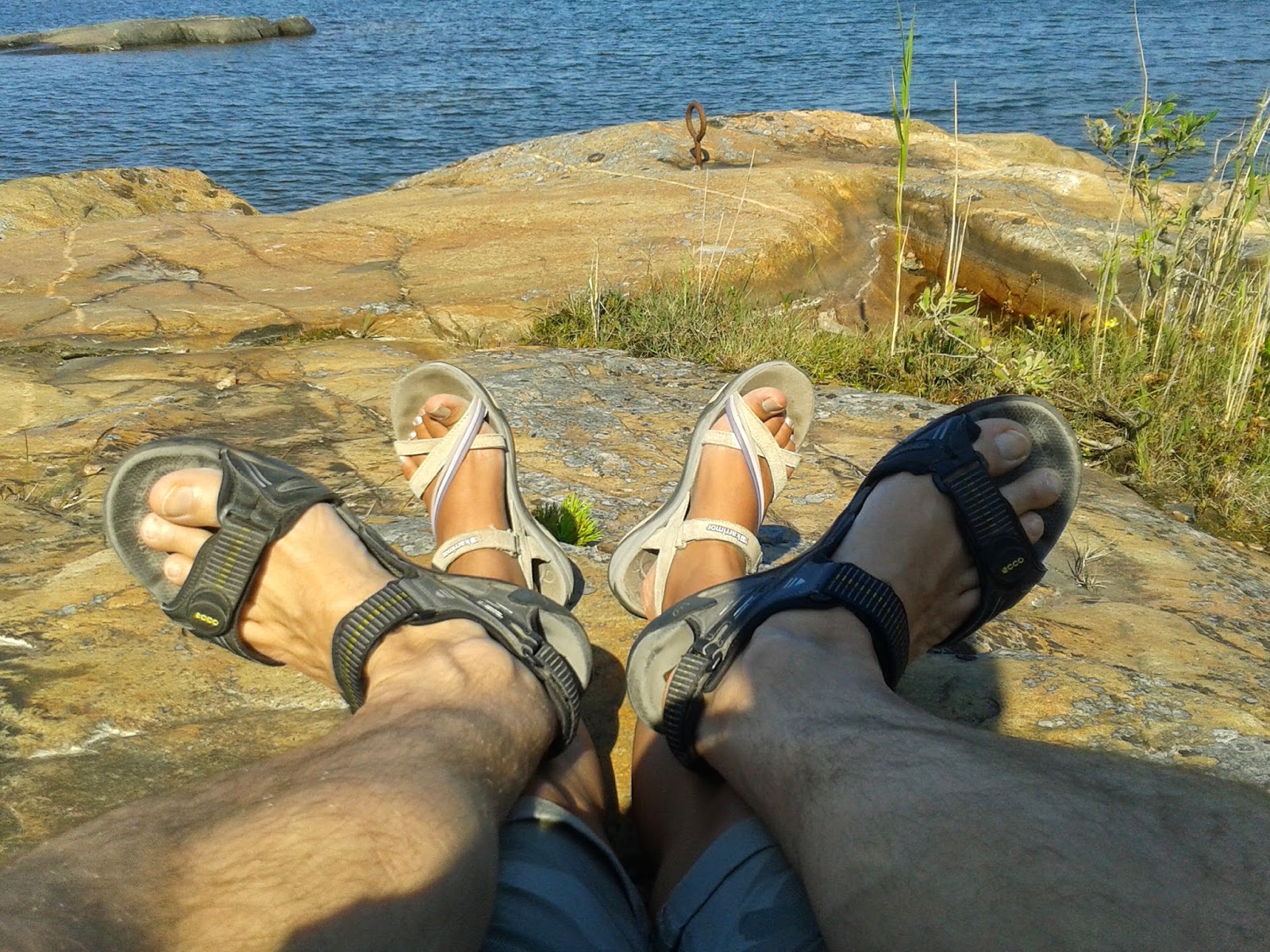
I have another friend who is truly connected to what she needs at a very intuitive level, looking at my summer experience through her eyes, I've spent my summer in ways that I needed, even if my brain and rational self might have suggested I needed a whole range of 'other stuff'. So it's all good, and it will all be good. Next week at this time I will probably be sitting in a boring meeting, without a t-shirt and kikoy, but wrapped up warmly in layers upon, upon layers of clothing and insulation (and not only from the cold weather). I suspect I'll be better prepared for whatever comes my way, and that is probably be the value gained from how I've spent this summer holiday.
I have another friend who is truly connected to what she needs at a very intuitive level, looking at my summer experience through her eyes, I've spent my summer in ways that I needed, even if my brain and rational self might have suggested I needed a whole range of 'other stuff'. So it's all good, and it will all be good. Next week at this time I will probably be sitting in a boring meeting, without a t-shirt and kikoy, but wrapped up warmly in layers upon, upon layers of clothing and insulation (and not only from the cold weather). I suspect I'll be better prepared for whatever comes my way, and that is probably be the value gained from how I've spent this summer holiday.
Wednesday, 11 June 2014
elephants in the room
The elephants in the room today were race and power. But aren't they always,...in the room? The workshop focus of the symposium today was really a stroke of genius and a wonderful attempt to invite conversation and dialogue. But the elephants were having none of it. None of the conversation and none of the dialogue. My head was dull from not having slept last night. I couldn't shut my brain down and I knew I would suffer in the morning and so I did. As a result I couldn't see and I couldn't really anticipate the movements of the agitated elephants in the room. I noticed them but couldn't make sense of their behaviour.
Academic spaces, like the one I was in today, are fertile grounds for power struggles. People parade and stake out their intellectual space. I am a Bernsteinian. I'm an academic literacies person. I am female. I have a PhD. I am a practitioner. I'm interested in the student. I'm interested in the curriculum. I'm using LCT. I dislike Karl Maton. I am black (or coloured, or white, or indian). In these uber-polite environments it's the person who wields their power through the eloquence of their words and the conquering up of theory to support their position that gets to dominant. Better still if they are able to evoke ontological debate and philosophy. Those unable to engage in this manner are simply present in the room, but definitely not guest of the party. That's the power first and foremost and how it is exercised.
 So what about race? Did my silence today have anything to do with my race? Or did it have more to day with my inability to communicate (or let me be frank, my intellectual incapacity to take up the debates)? To say that my perceived inability to engage in the conversation in the ways necessary to be recognised as a 'guest', is because I was denied the privileged of good schooling and opportunities because I'm black and grew up in apartheid South Africa, is condescending and deeply offensive and suggests a clear lack of understanding of the multiple factors that act to silence or amplify peoples' voices in any given situation. Such a view while tinged with the realities of being black, is limited and simply airbrushes, me Lynn, and all my agency (and that of my family) out of the picture. Yes I always mentally count how many black academics are in the room and my observations suggest that both in SA and aboard, typically, we are in the minority. But I'm not convinced that how we behave in these sittings are only determined by the colour of our skin. But I can understand and recognise that power evoked around race is still contentious and needs to be brought to the surface. I don't have the answers and feel that I might be 'outting' a somewhat assimilationist or dare I say 'colonised' view on race in SA through my articulations here. What I do wonder is how the symposium space could have been reconstructed in such a way to ensure that everyone felt more equal (on whatever grounds) and more comfortable to speak and voice their ideas. But maybe seeking equality in academia is an elusive notion and that's why the elephants in the room will always be allowed to go 'bos'.
Academic spaces, like the one I was in today, are fertile grounds for power struggles. People parade and stake out their intellectual space. I am a Bernsteinian. I'm an academic literacies person. I am female. I have a PhD. I am a practitioner. I'm interested in the student. I'm interested in the curriculum. I'm using LCT. I dislike Karl Maton. I am black (or coloured, or white, or indian). In these uber-polite environments it's the person who wields their power through the eloquence of their words and the conquering up of theory to support their position that gets to dominant. Better still if they are able to evoke ontological debate and philosophy. Those unable to engage in this manner are simply present in the room, but definitely not guest of the party. That's the power first and foremost and how it is exercised.
Tuesday, 10 June 2014
walk like an egyptian
Today I attended a symposium organised by colleagues at UCT. I did a short presentation focusing on how my PhD research incorporated the academic literacies and Bernsteinian perspectives. Surprisingly for me, the presentation itself was well received. I got some really complimentary comments, mostly about the research approach I used and how I was able to articulate what I'd done. Thankfully no real questions about the specifics. Although at the end of the day someone did 'corner me' and ask a question about the very specifics I was hoping would be overlooked. And I did struggle to provide a coherent, intelligent response, because as I realised, when mumbling through bits and pieces of what I did almost three years ago, I actually don't remember. No, maybe this is an unfair portrayal for my intelligence (and memory). What actually happened here is that I haven't yet considered how to mediate or translate the specifics of what I did during my fieldwork, or how I came to the interpretive stance I took to my analysis work, outside of what I wrote in the thesis. Without the steady, slow progress of the argument constructed by the structure of the thesis I was a bit lost.
This brings me to walking like an egyptian or rather walking, talking and behaving like a PhD academic. These events that bring together academics to discuss and debate a scholarly issue are very much like a particular kind of performance. You have to walk like an egyptian and my nervousness and anxiety before such events is usually because I'm never really sure whether I'll be recognised or perform appropriately as 'that' egyptian. Or indeed if I want to be a darn egyptian in the first place. When I was a masters student (and to a lesser degree a PhD student) or when I went to conferences as a 'practitioner' I felt less pressure to try to be the 'academic', 'scholar', 'Dr' - the egyptian in Egypt. In this early post-PhD phase I've become increasingly conscious of my identity and the identity projections of everyone else in the room. And so the mumblings I described above bother me even though I have a reasonable explanation for my response. Your thesis always needs mediation and translation especially when you are presenting it, or parts of it, to an audience not made up of your supervisors or examiners. A lesson I'm learning slowly and sometimes a bit painfully. But when in Egypt you have do what the egyptians do, no? The trouble though is that it's not always clear what that actually means, and to construct your own path through this environment, no matter how many times you've visited before, can be a risky business. But never fear, for now at least I'm an academic with a PhD and tomorrow I get another chance to trying out my own special walk, talk and way of being.
This brings me to walking like an egyptian or rather walking, talking and behaving like a PhD academic. These events that bring together academics to discuss and debate a scholarly issue are very much like a particular kind of performance. You have to walk like an egyptian and my nervousness and anxiety before such events is usually because I'm never really sure whether I'll be recognised or perform appropriately as 'that' egyptian. Or indeed if I want to be a darn egyptian in the first place. When I was a masters student (and to a lesser degree a PhD student) or when I went to conferences as a 'practitioner' I felt less pressure to try to be the 'academic', 'scholar', 'Dr' - the egyptian in Egypt. In this early post-PhD phase I've become increasingly conscious of my identity and the identity projections of everyone else in the room. And so the mumblings I described above bother me even though I have a reasonable explanation for my response. Your thesis always needs mediation and translation especially when you are presenting it, or parts of it, to an audience not made up of your supervisors or examiners. A lesson I'm learning slowly and sometimes a bit painfully. But when in Egypt you have do what the egyptians do, no? The trouble though is that it's not always clear what that actually means, and to construct your own path through this environment, no matter how many times you've visited before, can be a risky business. But never fear, for now at least I'm an academic with a PhD and tomorrow I get another chance to trying out my own special walk, talk and way of being.
Thursday, 29 May 2014
nothing will work unless you do
I read a lot of Maya Angelou in my early and mid-twenties. I was going through a 'feminist' phase, although saying this now sounds so wrong, implying that I'm no longer a feminist. Well it was a phase where I took a more hardline approach to all things gender related. In retrospect I was simply working out who I was and how I, as a black woman related to the rest of the world.
In the last two days I've been lucky to spend some time with two good friends/colleagues talking about me and my professional life post-PhD in direct and indirect ways. Reading some of the many obituaries and famous quotes from Maya Angelou I was drawn to this one 'nothing will work unless you do'. In both these chats the issue of writing as a survival and personal affirmation strategy came up, again in direct and indirect ways. I've put serious academic writing off for too long, citing all sorts of reasons not to make it a priority. I have to do the work to solve the problems I encounter, even if that work isn't what I initially expected it to be.
Maya Angelou to the rescue once again? Which makes me wonder if I've already figured out all I need to about how as a black woman I relate to the rest of the world.
In the last two days I've been lucky to spend some time with two good friends/colleagues talking about me and my professional life post-PhD in direct and indirect ways. Reading some of the many obituaries and famous quotes from Maya Angelou I was drawn to this one 'nothing will work unless you do'. In both these chats the issue of writing as a survival and personal affirmation strategy came up, again in direct and indirect ways. I've put serious academic writing off for too long, citing all sorts of reasons not to make it a priority. I have to do the work to solve the problems I encounter, even if that work isn't what I initially expected it to be.
 |
| I like this image. She looks directly into the camera, open, unassuming, comfortable. |
structure and agency
I have just a few common-sense observations and reflections to make about this oft discussed and theorised concern - structure and agency.
In the literature it's always wonderful to see the little person (aka - the agent) overcome or subvert the negative and even tyrannical impact of the society or the institution (aka - the structure). Of course all of this plays itself out in complex and diverse ways and as Margaret Archer and other theorists (like Bourdieu, who a good friend reminded me about recently) have shown us, the relationship between the structure and the agent is also interceded by culture. And I won't even try to pretend that I know anything about more psychologically informed understandings of these interactions. BUT theory-schemory when it comes to trying to understand your own place in an organisation and why it is you behave and react to events, incidents and people in the way you do. It's safe to say that I have enough of a common-sense understanding (and experience to back this up) to know that the environment that I live and work in will affect me as a person and in someways impact on, and direct how I response to what I encounter. I'm fast realising however, that irrespective how agentive you are as a person, you are still operating within a broader system that WILL either constrain or accentuate your level of agency. Also the conditions in environment can distort your ability to realise your agentive potential. It can also act to reframe and reconstruct your inability to use this agentive quality as a personal failing and in so doing turn the spotlight off the features inherent in the structure that directly act against this agentive potential. As I write this I imagine that somewhere in the literature, someone has already described this process in more elaborate and eloquent ways, and with just the right sprinkling of theoretical concepts and constructions to give it the necessary air of credibility and validity. I wonder though if anyone has ever written about how being caught in this process actually makes you feel, and how understanding these processes, no matter how rudimentary that understanding, offers no buffer against the person impact on its detrimental effects.
In the literature it's always wonderful to see the little person (aka - the agent) overcome or subvert the negative and even tyrannical impact of the society or the institution (aka - the structure). Of course all of this plays itself out in complex and diverse ways and as Margaret Archer and other theorists (like Bourdieu, who a good friend reminded me about recently) have shown us, the relationship between the structure and the agent is also interceded by culture. And I won't even try to pretend that I know anything about more psychologically informed understandings of these interactions. BUT theory-schemory when it comes to trying to understand your own place in an organisation and why it is you behave and react to events, incidents and people in the way you do. It's safe to say that I have enough of a common-sense understanding (and experience to back this up) to know that the environment that I live and work in will affect me as a person and in someways impact on, and direct how I response to what I encounter. I'm fast realising however, that irrespective how agentive you are as a person, you are still operating within a broader system that WILL either constrain or accentuate your level of agency. Also the conditions in environment can distort your ability to realise your agentive potential. It can also act to reframe and reconstruct your inability to use this agentive quality as a personal failing and in so doing turn the spotlight off the features inherent in the structure that directly act against this agentive potential. As I write this I imagine that somewhere in the literature, someone has already described this process in more elaborate and eloquent ways, and with just the right sprinkling of theoretical concepts and constructions to give it the necessary air of credibility and validity. I wonder though if anyone has ever written about how being caught in this process actually makes you feel, and how understanding these processes, no matter how rudimentary that understanding, offers no buffer against the person impact on its detrimental effects.
Subscribe to:
Posts (Atom)