Pages

Showing posts with label identity. Show all posts

Thursday, 13 September 2018

10 years ago

I was reminded today on Facebook, that 10 years ago I was preparing to leave South Africa to start my PhD journey. I packed up my flat (well almost) and sold practically everything and got on a plane ready for my new life, my new journey. Now 10 years later I can hardly remember the person I was in this picture - slightly tipsy, salsa queen, teacher, under 40 and open to learn and explore. Much of this blog bears witness to how those initial dream-like expectations and openness became fragmented and morphed into weariness and cynicism as my identity changed.
Strangely today I had a unrelated chat to a colleague who was conveying his observations of our mutual colleague who is currently doing his PhD. My colleague recounted how he felt his friend was descending into a sort-of deep hole of anger and despair, like all the joy was being drained from him. He no longer smiles. I nodded along and said, yes I recognise that. This PhD thing changes you forever. You can never come back. I'm not sure if I miss that person in the photo that I was. You can't miss something you struggle to remember.

Monday, 20 August 2018

on being a black woman academic in South Africa

This is a reluctant account of how I've experienced academia in South Africa as a black woman. In the last two or three years in the wake of the #Rhodesmustfall and #FEESMUSTFALL student protests and calls for the decolonisation of the curriculum, of the university, of alles, much as been said about the black experience of academia in South Africa. I've stood on the sidelines, feeling inept and ill-equipped to respond, to contribute to the debate and discussion. I worried that I lacked the necessary or appropriate theoretical or conceptual languages of description most of the other commentators were using and that my 'story' wouldn't line up perfectly with the kind of narratives getting the most traction. The main theme of most of these narratives is that academia is a negative and toxic place for black academics and that most universities, but especially the previously liberal white institutions, make it almost impossible for black staff to reach the same levels of achievement as their white peers or that when black academics do succeed, it comes huge personal costs. While, I'm not going to dismiss the validity of this particular narrative or the experiences of individuals that might have lead to the construction of this perspective of being a black academic in SA, I think some refinement and nuance could expand the narrative and reaffirm the variation of experience. Thus while this theme might be rather prominent in our current discourse, it is but a narrative; not the only one.

What's academia like - according to Lynn
Academia is not an open, inclusive and welcoming professional environment. Rarely will you be greeted at the gates with warm, open arms by colleagues keen to offer you all the support and development opportunities you need to become the very best sociologists, physicists, historian, economists, educationalist you can be. The progression up the ladder of success is clearly demarcated and carefully policed; then further tainted with visible and invisible hierarchies of status and privileged conferred on certain institutions, departments, individual scholars. So that your hard earned PhD might not be bestowed with the same quality or legitimacy, as those of your colleagues. Then it is unlikely that your hand be held by an experienced, seasoned and gentle scholar as you attempt to 'break' into the publication world, affirming all your ideas and writing attempts and ready to offer sage advice and a shoulder to cry on when the article you pissed blood to write, is unceremoniously rejected. Also nobody will be at hand to walk you through the indecipherable and many times incomprehensible application processes for study, research or sabbatical leave or conference funding. You will find lots of networks, cliques and cabals that advance their own interests and privilege. These are defined on the basis of discipline, sub-discipline, race, gender, or any other delimiter, arbitrary or not. So just like in high school, but unlike high school, the stakes here can make or break your research career. Similarly, it is assumed that if you have a Masters or PhD, you can teach, develop a curriculum and understand and implement the necessary pedagogic strategies deemed crucial to enhance your students' learning. Again don't expect that anyone will show you the ropes.

Academia is a highly performative environment where the object of display and performance is your individual cognitive and intellectual ability - all your worth is locked down in your capacity to display and prove your knowledge and intelligence associated with your discipline. Furthermore, the manner of this display and how you represent your intellectual worth is governed by particular norms and conventions very often linked to language use specific to your discipline or sub-discipline. So it’s not enough to know, you also need to know and master how to express what you know. If you are keen to move up the ladder of success within the academy you have to show excellence in teaching and scholarship. However, in most university sectors, both locally and internationally, research trumps teaching. So in order to build your research profile and publish you will have to, especially in your early career, do most of your research and publication writing after hours, because most of your 'work hours' will be spent servicing your teaching and administrative obligations.


Unfortunately, the discrimination, prejudice, racism, sexism, ageism and meanness that pervades our society isn't blocked at the university gates. Instead it finds fertile ground and is accentuated in a professional environment built on the mostly subjective evaluation of intellectual acumen; with the one's doing the evaluation imbued with all the power. Add to the mix a healthy component of mean, egotistical people who come in all the race, gender and class shapes and sizes, and you have a setting for a perfect storm.

Insert Lynn - a black woman academic
  • I've worked in higher education for more than twenty years, doing many different things. I started to lecture just over 15 years ago, but I only started to self-identify as an academic about 10 years ago when I started to engage and participate in the scholarly debates and dissemination of knowledge associated with my disciplinary field.
  • I've only ever worked at a historically black institution (although now it’s part of a merged institution).
  • The only position I was even held back from was for a more senior coordinating role. Even though I was more qualified (I was the only lecturer with a Masters degree) and had more experience than my colleagues, my black male boss at the time didnt think I was suitable. I was the only female working on the programme and the position was awarded to my male colleague.
  • A request for conference funding was once turned down by my black male boss. I decided to pay for the conference myself.
  • I was removed from my teaching allocation on a course by my black male boss, because I was deemed to be too critical of the curriculum content and pedagogic approaches used. He also refused to appoint me as course leader even though I was the only female PhD lecturer in the department, and the course I was teaching on was in my specialist area. I had to 'report' to a junior female member of staff who had a contract position.
  • Male colleagues of all hues and persuasions have thought it ok to comment randomly on my appearance, clothes, weight, marital status, or disregard my title in communiques while paying careful attention to correctly apply the all important, prefix signifiers of rank, when referring to all the other male recipients.
  • I have been referred to as a 'token black' by black female colleagues, who seemingly feel I'm not suitably qualified to work in my current domain, even though they don’t have any experience in the said domain.
  • I have encountered black male colleagues who fail to acknowledge both my qualifications and reporting role, and constantly defer to my white male boss, even when I'm at the same meeting.
  • I've seen how white research networks operate and how access to these networks are carefully controlled. Membership is bestowed to only the most suitable black academics. When you say no, you worry for your reputation and career progression.
  • Friendships, authentic collegial and intellectual engagements are possible across race, class, gender and age divides. It’s hard to find, but I've flourished as an academic from the many genuine and supportive relationships I've managed to develop at my own university and with colleagues in my region and internationally. These relationships jump happily cross whatever  race, gender, class, age, cultural 'barrier' put in its way.
MPhil, UCT 2007

So what is it like to be a black woman in academia in South Africa? It depends really - on where you work, who you work with and who you work for. All these variables along with who you are as a person will coalesce and determine what it means for you. It’s a tough space, generally, and there are personal and structural factors that either compound and exacerbate that toughness or smooth it over. 

For me being an academic is almost a constant struggle against all that I am, because who I am is in so many ways at odd with the norms, conventions and predispositions of academia. The academy and its many people, unfortunately, have a low tolerance for difference – so if you don’t look, sound, behave, think or share the same values as those who have the power to define the norms and conventions – then you are more likely to have a difficult time. And often time the structures inherent in the institutional fabric will allow those in power to exercise their power in harmful ways. I’ve been on the receiving end of this kind of power (and meanness) held by both white and black men and women. In spite of this I've been moderately successful, I believe because I have, in part, being able to harness social capital gained from going to a white university and then completing my PhD in the UK. But I also have a particular personality - 'I don't take kak from kabouters' - and if I want something I find a way, legally and ethically, to get it. And I 'graf''. I do the work. Some of the challenges I face are linked to my race, ethnicity and gender, others reference the cultural capital I either possess or don’t (manifested in how I sound when I talk or my writing style). Luckily for me, these challenges, have been only that - challenges, that I constantly have to work at and navigate around. And I’ve found support in the most unlikely places and so have avoided those perfect storm conditions, that can make your life as an academic truly toxic and negative. 

This is a reluctant and incomplete account of being a black woman academic in South Africa - heavily inflected by time and place. I've tried to make sense of my own experiences and how it 'fits' into other narratives and discourses circulating at the moment. Hopefully, my story doesn't deny the other stories being told, but builds out just how discrimination and power manifests within the university. 

Sunday, 12 August 2018

academic writing: a view from the sidelines

I'm on the sidelines as I watch other people write. Before I had only ever observed and reflected on my own experiences of trying to be an academic writer, as much of this blog bears testament to. I thought, naively, that my own struggles with academic writing would prepare me and allow me to be the supportive, encouraging and understanding 'coach', very optimistic and enthusiastically cheering from the sidelines. I thought I would understand and would comprehend.


This is what I brought along to my sidelined observations: Academic writing is difficult, in the beginning, especially, you think you can write but the reviewers often say you can't. Understanding and applying the 'conventions' and stylistic norms that will allow your writing to be recognised as legitimate is not as easy as 'copying' the forms and styles used by your favourite author. Sometimes doing this, simply signals now 'wrong' you got it. Writers, and especially novice writers, struggle with the huge psychological burden of knowing they don't 'come' with what they think are the necessary or expected linguistic repertoires or fluent and extensive vocabularies. And many times these very resources, especially when they are not recognised or (mis)recognised, mark these writers as 'outsiders' and becomes the source of a vicious and crippling circle of shame and fear associated with academic writing. Reviewer feedback is overwhelming, especially when its not filled with overt praise and affirmation. Its very hard to unbundle your personal and emotional investment in an argument, a sentence, a paragraph, an idea from commentary that suggests, someone else doesn't actually understand or get what you are saying.

From my own writing experiences and trying to mediate all the factors listed above as they play out in my own journey as a somewhat reluctant and self-conscious academic writer, I know that it always takes way longer to write a sentence, a paragraph, an article than you anticipate. You have to work through the reviewer comments carefully and try to see beyond your attachments. You have to seek out feedback and opportunities to talk and talk and talk some more about your work, your writing. And you have to continue to write - you have to put an immense amount of effort, energy, commitment into that act and work through all the freaking demons, weighing you down and distorting your own sense of yourself as a writer.

I'm reminded of the old adage about being a good, effective teacher: You have to grasp the limitations of your own experiences of being taught. As a teacher merely repeating what you saw your old teachers do can frequently leave you on the back foot. Even if you experienced really good teaching - simply emulating your past teachers, without trying to critically interrogate the usefulness or suitability of their practices - can severely limit your own teaching practices and your growth as a teacher. This lesson, is ringing true for me now. I'm finding that my own ongoing journey (very ongoing) as an academic writer has not equipped me as well as I would have hoped, to really understand, let alone support, others on this very same journey.

Monday, 7 May 2018

making meaning of 'sabbatical'

I've been in Sweden for a month and I'm starting to wonder more seriously about what it means to be on sabbatical. As part of my leave application I had to list all the expected outcomes for this period. They were all written artefacts - publications in accredited journals, editorial activities for the edited collection I'm working on. All writing tasks. So it would seem my sabbatical is all about writing. But what about just reading (anything), just thinking, just walking, just doing 'stuff' I wouldnt normally do back at my desk, in Cape Town? How do these activities fit into my sabbatical plan?

I've been writing, making slow, but I would also say, stead progress on that highly prized 'journal publication'. Most mornings I get up around 7 and I'm at my desk at BlĂ„senhus or the sunny dinning-room table at the flat by around 9:30am. I have that same anxiety and then guilt that I had for much of my PhD about not writing enough, not writing fast enough, not doing more. On Thursday a colleague back home said to me jokingly, when I mentioned I had a hard, long day, 'Are you working? Aren't you on sabbatical?' Made me think! In no time I will have been here for two, three months and all I will have to show are those written (incomplete?) artefacts. My neck and shoulders will still be rock-hard and sore, my body will continue to be stiff and inflexible, the sadness, worry and displacement I've been feeling for months before arriving in Uppsala will still be warmly nestled in my being.  I will also berate myself for my inability to calmly respond to the workplace stress that will surely greet me on my return.

So what is this sabbatical about then? Yes it's about writing - it's about finding the joy, and not only fixating on the terror, and weight of writing. But it's mostly about me, Lynn, the academic writer, the academic and teacher. It's about valuing and accepting how I am as an academic writer, how I write academically, what kind of academic writing I do and why I write the 'stuff' I do. It's also about me, Lynn. Just me, Lynn.

Friday, 27 April 2018

relationships in academia

Relationships of any kind can be tricky and complex at the best of times. In the university and academia more generally, the structural and organisational systems, that give life to ego-saturated status and rank  differentials, over and above the complexities of interpersonal interactions, make for a difficult terrain to navigate. I've learnt a number of hard lessons, bruising lessons about how this can play out over the last six months or so. And while living through this period, I suspect my immersion in the day-to-day specifics of 'who said what', and 'who did what to whom', and 'what does this mean' and 'how shall I respond', left me a bit blindsided and unable to appreciate a more helicopter-inspired perspective on - relationships in academia. Yesterday in some sort of strange way (no such thing as coincidence) I 'suddenly' caught a glimpse of this enriched vantage.

Two things happened - interlinked, implicated - at the level of both the concrete, the visceral. A reflective piece I co-wrote with LT was published and we decided to share it. So I was copied into an email that saw this piece travel across distant lands. I also heard of the death of a well respected, admired and beloved academic. We interacted with each other on many occasions in very collegial ways, and I am very familiar with, and have at times, extensively use her scholarship, but ours was never more than a professional relationship. I am however, privy, through my connections with colleagues who were very close to her, to their hugely meaningful and deep interpersonal relationships. And, yesterday to some of their heartfelt sadness and devastation because of their loss. Both these examples made me think anew about the relationships within the academy that I have been able to forge or those that have floundered or more dramatically, exploded. I wondered about the degree to which the academic setting acted against or contrived to scupper the chances of meaningful personal connection as we race to 'put ourselves out there' and gain academic recognition through primarily, the high stakes activities of publication and research outputs.

The reflective piece, which in many ways details an evolving friendship birthed in and through the university, and my second-hand insights into the multiple ways in which BL transcended the academic setting to nurture deeply meaningful and authentic interpersonal connections with many of her colleagues, draws attention to how relationships can be different in academia. Maybe I haven't realised it before, but these are the only kinds of relationships within academia I am keen to foster and give attention. It means that I have to personally act against the structural mechanism that pull me into viewing colleagues as adversaries or using my rank and status to undermine opportunities for meaningful connection with others. It also means I have to avoid situations and people who cant appreciate this way of doing relationships in the academy. Where I cant carefully avoid this (at least 60-70% of the time), I have to see it for what it is, disconnect and tell myself, 'this isn't for you Lynn, just try to be respectful and keep it strictly professional'. To Brenda, Hamba Kakuhle!

Sunday, 3 August 2014

the trouble with a PhD

Doing a PhD changes you. You never come out of the process the same person who went into it. The trouble though, is that the 'change' is unknown or unpredictable. Most universities, like the OU, outline their expectations for the type of PhD graduate they hope the process will produce. So it's fairly reasonable to assume that 'out there' are a 'standard' set of characteristics or dispositions, which a fairly large group of interested people, expect someone with a PhD to possess. Now some can embrace all these changes and in fact, they change in ways that almost map on directly to these expected characteristics deemed important. They meet their own expectations and those of others, of the person you're meant to become as a result of the PhD. And I think when that happens, it's great, because of course it validates the process and makes all the sacrifices,one invariably makes when embarking on such an intense learning process, worthwhile. There is a sense of achievement and personal reward and fulfillment. I'm glad to say I know a few people who have experienced the PhD in this way, and have revelled in the many positive and validating outcomes of the PhD experience in both their personal and professional lives. The positive personal impact of the PhD is undeniable.

Others, struggle more with the changes that have occurred and even more importantly, with the expectations of change and types of changes, others expect. I've always been wary of the changes that might happen to me as a result of the PhD, and in many ways this is what kept me from embarking on the process sooner than I did. I was scared that I would change in particular ways - not that I knew exactly how these changes might manifest - I was just apprehensive. And while you can sometimes see or experience how you are changing, while in the middle of the whole thing, I think the full extent of your metamorphosis is only fully realised when you have to re-immerse yourself into 'normal' life and start to bump up against your own new view of the world and the reconfigured expectations of others. I'm feeling this conflict and discomfort profoundly at the moment. I'm trying to work through my own internal conflicts about the changes that I've undergone, but find I'm also confronted by having to negotiate and mediate other people's expectations of me, Lynn with the PhD.

I had an e-mail just yesterday from a friend of mine in England - we did our PhD's together at the OU. He never went back into higher education after he completed his doctorate and is now working voluntarily for an archeological society. He too spoke about the trouble the changes that the PhD demands and is responsible for, and the difficulty with settling back into old environments post-PhD. It's reassuring to know, one can just cut-out your own pathway and that all those letters 'behind your name' don't need to prescribe or determine who you are, what you do and who you want to become.

Tuesday, 10 June 2014

walk like an egyptian

Today I attended a symposium organised by colleagues at UCT. I did a short presentation focusing on how my PhD research incorporated the academic literacies and Bernsteinian perspectives. Surprisingly for me, the presentation itself was well received. I got some really complimentary comments, mostly about the research approach I used and how I was able to articulate what I'd done. Thankfully no real questions about the specifics. Although at the end of the day someone did 'corner me' and ask a question about the very specifics I was hoping would be overlooked. And I did struggle to provide a coherent, intelligent response, because as I realised, when mumbling through bits and pieces of what I did almost three years ago, I actually don't remember. No, maybe this is an unfair portrayal for my intelligence (and memory). What actually happened here is that I haven't yet considered how to mediate or translate the specifics of what I did during my fieldwork, or how I came to the interpretive stance I took to my analysis work, outside of what I wrote in the thesis. Without the steady, slow progress of the argument constructed by the structure of the thesis I was a bit lost.

This brings me to walking like an egyptian or rather walking, talking and behaving like a PhD academic. These events that bring together academics to discuss and debate a scholarly issue are very much like a particular kind of performance. You have to walk like an egyptian and my nervousness and anxiety before such events is usually because I'm never really sure whether I'll be recognised or perform appropriately as 'that' egyptian. Or indeed if I want to be a darn egyptian in the first place. When I was a masters student (and to a lesser degree a PhD student) or when I went to conferences as a 'practitioner' I felt less pressure to try to be the 'academic', 'scholar', 'Dr' - the egyptian in Egypt. In this early post-PhD phase I've become increasingly conscious of my identity and the identity projections of everyone else in the room. And so the mumblings I described above bother me even though I have a reasonable explanation for my response. Your thesis always needs mediation and translation especially when you are presenting it, or parts of it, to an audience not made up of your supervisors or examiners. A lesson I'm learning slowly and sometimes a bit painfully. But when in Egypt you have do what the egyptians do, no? The trouble though is that it's not always clear what that actually means, and to construct your own path through this environment, no matter how many times you've visited before, can be a risky business. But never fear, for now at least I'm an academic with a PhD and tomorrow I get another chance to trying out my own special walk, talk and way of being.

Saturday, 3 May 2014

taking the weekend off

The PhD experience instills a strange discipline or guilt  - depending on how you want to view it. Your work is a constant feature of your life, and if you are doing a full-time PhD the days of the week are practically indistinguishable from each other. Basically, weekends don't exist. I had a rule of working a six-day week. Since I was relieved of my teaching responsibilities my weekends have pretty much become weekends. Unless I've been working on some or other writing project, my weekends have become a time when I do the things normal people do on a weekend. I was surprised to acknowledge last week, that I did not check my e-mail for practically most of the weekend. More surprising is that it didnt really bother me. Of course there is that niggly bit of something I feel, a slight discomfort at doing 'nothing' or having 'nothing' of value to do (reframed this means that only real academic work - aka, writing or research - is of value). Last time I wrote about how writing and identity are two sides of the same coin, a similar claim could be made that academic work and identity are two sides of the same coin. So is it any wonder that my work, or guilt, or discipline associated with my work follows me into the weekend?

Thursday, 30 January 2014

being a teacher again

Next week I will once again become a teacher. I'm returning to the HE classroom after a five year absence. As I've been trying to work on my preparation for this move back into a role and identity I was most proud and happy to have, the complexities of how to embrace this old and familiar identity within the context of my current position in my department has been brought into sharp focus. Before I had almost complete autonomy over all aspect of the subject curricula I taught. I was the only person teaching the subject, it was my domain and I was indeed the queen of that castle. I could approach the subject content and its underlying philosophies and pedagogy in the way I saw fit. This year it's all very different. I'm one of three people assigned to teach the subject and it's not been easy negotiating for the opening up or creation of a space where issues related to the curriculum and pedagogy can be discussed. And I'm not happy with what I've seen. There are glaring omissions and misalignment in relation to issues related to choice of content, pedagogy, and assessment strategies and importantly to me, the lack of responsiveness to students and their needs and what they bring to the learning context. It hard for me to turn a blind-eye: in respect of my teaching I usually don't do half-measures, I don't easily settle for mediocre or anything other than active learning. I'm ruffling feathers because I'm asking questions about the nature of assessments, the lack of time devoted to orientation and induction into the subject content, the department, the institutional ways of being, the type of classrooms I'm required to conduct my lectures and practicals in, the validity of the promotion of a decontextual skills orientated philosophy to the course content. But next week I meet my students and I'm excited about that - I'm keen to see how my PhD experience will impact on my pedagogic practice and how the learner role I've occupied over the past five years will act to sensitize the teacher role I now have to step into again.

Saturday, 11 January 2014

what now?

The corrections are with the Research School and I guess it's practically over - the PhD that is. So I've been wondering what to do with this blog. I'm not sure  - I started the blog as a way of reflecting on my PhD journey and now that I've reached my final destination I'm not what function the blog might fulfill. I don't want to stop blogging but I'm not 100% sure how to make the blog-transition from the PhD to my next journey. At this point I'm not exactly sure what they next journey will be or rather what story I want to tell about my life post-PhD. I'm gonna have to think about this a little bit more and possibility use the blog as a canvas for my explorations. The blog, my blog, I think is robust, it can deal with some eclectic meanderings - a little bit of this, a tiny bit of that and viola! Hopefully something new, yet familiar.
 

Thursday, 22 August 2013

transitioning 'Groundhog day'

No I'm not Bill Murray - but I am referencing his experiences from the movie of the same name. I can't seem to move beyond a transitioning state of being. I feel like I'm trapped in some liminal space never able to leave. Just when I feel some stability is finally approaching, I'm thrown back into an in-between space never able to build, develop or establish an identity beyond one transition to something else. So what the hell am I? What purpose do I serve? And what the hell does it mean to have a PhD in Higher Education Studies? (and I should add within a university of technology setting!). Having just submitted the thesis I feel myself holding onto the 'PhD student' experience and identity. Well it took me practically four years to cultivate. It was such a certain thing and being at the OU provided the necessary social and cultural 'props' required to take on that identity. Now back at work, I'm not sure what I am. I'm out of touch with the realities of my institution, the teaching context, the people, the politics. I appear to be floating from one area of 'work' activity to another. I say yes to almost everything people place in front of me because I don't want to appear as if I'm trying to lighten my load, I want to fit in, and I don't want to seem like I'm above 'certain' kinds of tasks.

Recently I've been asked to do two presentation based on my research - not that anyone is really interested in my research - simply because I have done 'the research'. You've done a PhD now talk about it - I feel is the main motivation behind these requests. You've done a PhD now sit on our committee dealing with postgraduates in the department. I work in an IT department - what the hell do I know about IT of any sort. I can see myself being roped in to 'supervise' students doing Btech and Mtech degrees in IT because as someone put it, when I remonstrated that I'm not sure what I can contribute 'All research is the same'. I wonder if it's worth arguing against such a statement. On the somewhat bright side of things, working means a proper salary or maybe more appropriately for me at the moment 'danger pay'.

Friday, 5 April 2013

last day at the OU again

I'm sitting at my desk at the Open University for the last time. Well technical it's not the last time I will be sitting at a desk at the OU, but it's the last time I sit at my desk. Changes are underway in IET and for the the 'old' batch of research students, this means that we are being relocated. When I come back to the OU in September/October I won't come back to my old desk. I've taken down all my postcards and the hand-made drawings of my nephew and niece. I've cleared away all my personal artefacts, my cup is safely packed away in a bag. Now my desk looks almost identitical to those on either side of me. Slowly, it would seem, the world I knew as the OU is disappearing. Many of my cohort colleagues and friends are no longer students or are in other countries. So unlike when I left in September, this time it feels like it's for real. When I next return nothing will be as it was when I left - of course 'nothing' can be the same - but all resemblances of what it was like to be here will be gone - shattered and fragmented - only available to me through my memories and possibly the odd photo. I feel like I will have to hold the past four years in my memory because there will be nothing tangible or physical left to give it some meaning. It will all be sitting in my head, almost like a construction - real but imaginery too.

I'm glad I'm going home...Only two more sleeps I tell myself. I've started to work actually, in the last dying days of my stay. Working through my data chapters - the ones I need to cull. I'm reworking, reordering, rewriting sections of texts or simply marking up text that needs to be cut or rewritten. The beginning of the very end. It feels good, but also sad. I've been a PhD student for such a long time now, what will I do when I'm no longer that? What new identity will I have to get used to then?

Tuesday, 1 January 2013

a year in review

It's 2013 baby! I feel like my feet are stuck in cement - grounded in one place. The positive aspect is that I'm grounded.

This is what people tend to do at this point in the year - reflect on the past year and look forward to the new one with high expectations. I've been thinking about 2012 for the past few days and had this real sinking feeling. It hasn't been great for my PhD. For one thing, I didn't finish the PhD as I had hoped in 2012 - I didn't even get close to finishing the PhD in 2012 which was the plan B. In fact when I left the UK in September I had five written chapters, at the end of 2012 I have five written chapters. It doesn't really matter that I have five marginally better written chapters than I had in September, I still only have five after three months in Cape Town. While returning to Cape Town has been in many ways a frustrating experience in relation to the PhD - as I struggled to make the transition back to my life here and then encountered one problem, challenge, set-back, distraction after the other which rendered me almost paralysed - I started to 'get' the PhD, I discovered some joy and positivity in the whole experience, I like what I'm doing and even with all the dark clouds looming, as I hint at above, I know what the PhD is actually about and I know it will make a plausible contribution to the field. I freaking have a contribution to make and it isn't 'mickey mouse' either.

But the year has left me shell-shocked, my confidence is at its lowest, I don't know where I belong and who or what I am - a lecturer? but in what?, a curriculum specialist who hasn't been working at a SA institution in four years?, an academic development practitioner out-of-touch with the realities of academic life and students learning within the SA higher education context?, a colleague but with what affiliation? and with what authority do I make all these claims and professional identity statements? The only thing I know and what feels most real is that I'm now a fourth year, unfunded PhD student at the Open University - but that is so disconnected from my current context and reality and buys me so little except maybe sympathy or disdain (depending on whose looking in)

I have to start chopping away at the cement that covers my feet and restricts my movement. I have no resolutions for the new year, except a deep desire to finish my PhD before I go into the second half of the year. I have no choice, I can only hope that all the bits that make up who I am can come together and pull in unison to help make this desire a reality. At the moment I feel like I have no choice but also no control and I need to wrestle back control in order to stand any chance of making 2013 a lot brighter than 2012.

Friday, 14 December 2012

just a little thought

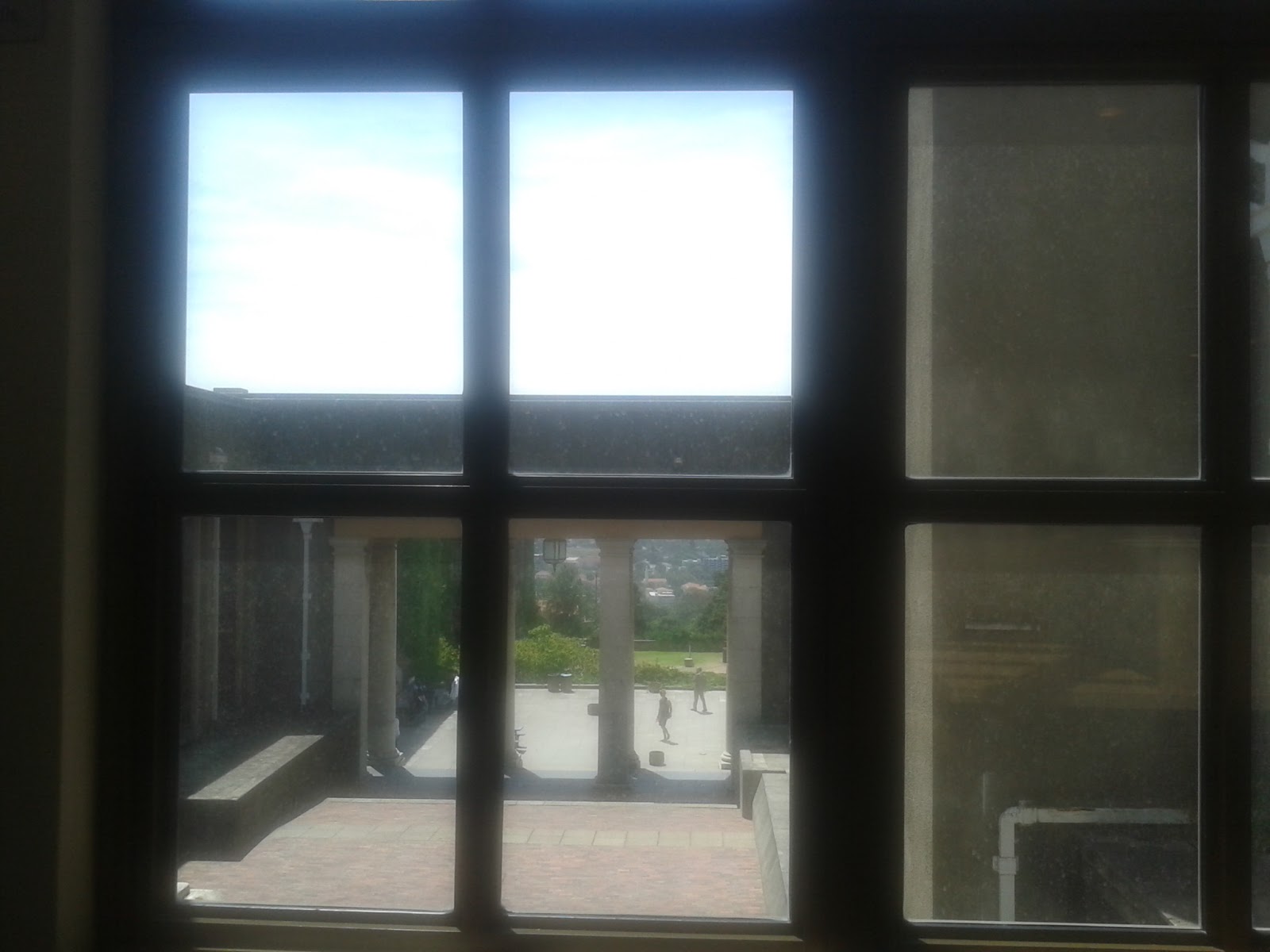
a crap picture of my window view from UCT library
Yesterday while sitting in the UCT's library and watching students gather for their graduation ceremony outside Jameson Hall I had this thought. I had been reading through and reflecting on the comments I received from a really insightful 'reading' of my methodology and data chapters. I felt like I finally knew what this thesis was about and in that moment I felt so powerful, so in control and in charge. It made me wonder why this feeling was so silent from the rest of my experiences of the PhD. It reminded me of something I was taught as a really young person while grappling with the ideology of apartheid. I came to understand that it is in the oppressor's interest never to allow, or to severely restrict the oppressed's realisation of the power they have to change the situation and this mechanism functions to keeps them in continual oppression - I've often heard Bantu Education explained using this analogy. But it rang true for me too.
I thought 'Imagine if I realised or was constantly encouraged to see my power throughout the PhD experience? Just imagine!'

That glimmer of the power of my insight and developing understanding of my thesis now needs to be cultivated - I must never lose sight of it, in fact it must be nurtured and allowed to blossom. Therein lies the possibility for turning things around.

Wednesday, 22 August 2012

writing, writing, writing again

I'm working on the first draft of my conceptual framework (aka - literature review) and I experienced the classic sequence of events. I avoid doing the writing for as long as I can, but once I start it's 'sort-of-ok' until, of course, I encounter the first of many stumbling blocks in the writing process. So at the moment, it's sort-of-ok! I know it's not going to be the version that makes it to the final thesis, but it's a start to that process. I spoke to someone who is working on her second thesis draft and her advice was 'don't put too much effort into it because at this stage you don't know where you're taking it and you might end up trashing large sections of work you were sweating over for weeks - the effort can come at a later stage when you are more clear of the direction you plan to take'. Good advice but in order to follow this advice, which is somewhat counter-intuitive to how I tend to work, I've really had to consciously stand back from my need to get everything right the first time. But with my deadline looming I've been forced by necessity to just go with the current version of the conceptual framework. So I'm just tying up loose-ends and making my current argument as articulate as I can. I'll have to wait for feedback and then see where it take me.

One thing that is rather prominent in my writing is it's South African flavour. I'm relying very strongly on SA researchers and scholars. Thinking about this today, as I quoted yet another SA researcher, I wondering if this was partly to make a very important point about the validity, relevance and credibility of SA research. Also I suspect that very few people here might have read the work and maybe this is another way to draw attention to and promote the depth and value of the insights presented in the work. And of course to very clearly signal my identity and allegiance. Selfishly though, I thought - well maybe I can also vicariously gain kudos through the work of my esteemed country men and women.